(Here is a report by Yumiko Kikuno of the Peace Boat call to Vancouver in May 18th, 2007. This was their 56th world voyage, which I participated as a guest educator between Acapulco and Vancouver. See the index on the right and click 'Peace Boat' for related postings. Thank you Yumiko for sharing this report with us!)
At this time of year, I see various types of deluxe cruise ships docking at the international ports in Vancouver. I sometimes guess their destinations, imagine their luxurious lives on board, and feel a little “jealous.” In May 2007, the ship, which has “Peace Boat” written on its body, called at Canada Place. It did not look like a “floating gorgeous hotel,” but its name “Peace Boat” stimulated my inquiry.
The Peace Boat is an international NGO whose mission is to build a culture of peace by linking people around the world, providing passengers with unique educational programs during its voyage. The Peace Boat’s first voyage, which set sail on September 2, 1983, was organized by a group of Japanese university students. At that time, the Japanese government was criticized by neighboring countries because they distorted history in school text books about Japan’s past military aggression in the Asia-Pacific. Young people, therefore, who started to have questions about history education in Japan, established the Peace Boat to research the facts of history and to focus on international exchange--people to people-- with a goal to build peace around the Asia-Pacific.
The most important characteristic of the Peace Boat is what brings reality into the programs: mobility. Because participants learn the issues of a country through workshops and lectures on the way to the next destination, they are able to address the theme more deeply when they explore the city and communicate with the local people. In other words, just after participants learn the topics of a country, they will actually see the real situation, not on TV or in a movie, but in person. Another exciting contributing component of the Peace Boat is that passengers have plenty of time to develop their new perspective and to organize their opinions without the typical distractions of work and family responsibilities. Moreover, after workshops or lectures, specialists (guest speakers) are still on the ship; participants therefore have many opportunities to ask them about the topics anywhere: at a restaurant, on the deck, and even in a washroom.
While the Peace Boat was sailing up to Vancouver, passengers had opportunities to learn some issues about Canada. This 56th cruise, North Vancouver’s Peace Educator, Satoko Norimatsu, founder of the Peace Philosophy Center, a place to facilitate learning for peace and sustainability, boarded the ship in Acapulco, Mexico as a guest speaker. She demonstrated at her work shops how to understand intercultural communication with her unique perspectives and introduced multiculturalism in Canada and peace activities in Vancouver. In addition, Theresa and Carrielynn, a First Nation’s hip hop group in Vancouver, accepted an invitation from the Peace Boat because they thought it would be a great chance to access different audiences, share their story, and they liked one of the Peace Boat’s philosophies: building a great understanding in cross cultural integration. They gave a lecture to tell what exactly happened to First Nation’s communities after Europeans had arrived. For example, abuse had never happened in their society till the residential school, where aboriginal children were taken from their family and forced to be institutionalized, era started. In fact, First Nation’s people deal with many issues: poverty, drug addiction, abuse, and so on. Theresa said, “We still suffer from colonization, but I do not intend to blame somebody for our tragic history. I just want to eradicate the wrong doings.” Finding out the root cause should be one of the paths to healing. At the end of interview, at the office of KAYA (Knowledgeable Aboriginal Youth Association), her face looked bright with hope, the young aboriginal hip hop star said, “We have survived, we are still here, and I want to be an example of how to find a way to fit to contemporary society with our own traditions.” When arriving in Vancouver, some passengers participated in a tour, visiting the Museum of Anthropology at UBC and the Aboriginal Women’s Center, where they enjoyed traditional meals, workshops, and performances.
Vancouver will be the destination of the Peace Boat’s 58th voyage in September 2007. When I see the Peace Boat at Canada Place next time, it will remind me of the message from Theresa to young aboriginals: keep your boat afloat. There are many problems all over the world, such as war, environmental pollution, and poverty. We should find creative solutions to preserve the space ship “Earth” as the Peace Boat floats on the ocean.
For more details:
Peace Boat: http://www.peaceboat.org/index_j.html
Yumiko Kikuno, peace journalist
Showing posts with label Peace Boat. Show all posts
Showing posts with label Peace Boat. Show all posts
Friday, September 21, 2007


Monday, May 28, 2007
Peace Boat Experience I
 Please see this previous posting for the introduction of Peace Boat.
I participated in the Peace Boat 56th Global Voyage as a 'mizusaki-annnai-nin' or a guest educator, for nine days from Acapulco,Mexico, to Vancouver. This ship, called Topaz, carried about six hundred passengers, a smaller group than the usual nine hundred or so. There were two big age groups on the ship - the young ones from late teens to early twenties, and the mature ones in their late fifties and above. This is understandable as it must be hard for people in their thirties and forties, typically in their full-time working years, to participate in the three-month long world voyage. (Photo: Peace Boat at Acapulco Bay)
As a mother of two young children, it was the first time in years that I spent days without seeing small children. The youngest passengers on this cruise were junior high students who should be fourteen or fifteen years old. I was told that some cruises do have many children, so they provide family-oriented activities on the ship.
This ship never sleeps. The young ones stay up late and some go to bed at 4 in the morning, when some of the older ones are getting up. So morning events typically had mature audience, and the late-at-night events the younger. The prime time on the ship therefore was from around 4 PM to 9 PM, when both young ones and old ones were awake. I was wondering how people could manage their boredom while cruising for days between ports of call, but I knew I was mistaken as soon as I boarded Topaz.

From 6 a.m. to past mid-night, there were numerous concurrent events of all sorts, from morning exercises (Radio-Taiso), Spanish and English language classes, a variety of lectures, to sports activities and dance lessons,organized by Peace Boat and passengers themselves. The boundary between the staff and the passengers seemed thinner than I wo uld have expected -sometimes hard to distinguish between them. Some passengers were really involved, like being broadcasters of the in-ship TV station, and reporters of the in-ship newspaper which is published in Japanese and English every day.
 uld have expected -sometimes hard to distinguish between them. Some passengers were really involved, like being broadcasters of the in-ship TV station, and reporters of the in-ship newspaper which is published in Japanese and English every day.
As a guest educator, I had to and wanted to make the most of my limited time on board for the benefit of passengers and staff. To share what my life was like on the ship, here is the schedule of one of the busier days when I had four of my events in a day. (Photo: my introductory presentation on May 13th)
A.M.
8:30 Breakfast
10:00-12:00 Film and Discussion
10:00-12:00 Film and Discussion
P.M.
12:00 Lunch
2:00 - 3:30 Presentation: Peace Activities in Vancouver
3:45 - 4:30 Q & A Session: Study Abroad and Homestay
4:30 - 5:30 Interview for the newspaper next day
5:30 - 6:30 Dinner with other guest educators and staff
7:00 - 8:30 Intercultural Communication Workshop
9:00 - 9:30 Meeting with Peace Boat staff
9:30 - Had drinks with Peace Boat staff at Izakaya 'Namihei'
A day on the Peace Boat seemed like three days. I wondered why I got so much done but still was able to get decent sleep at night. Yes of course, I had no kids to look after, no meals to cook, no laundry to do and no floor to sweep! What a privileged way of life! Here I must mention this is also because of the incredible dedication of the Peace Boat staff and volunteers. They cut down their meal time and sleep to organize all these events and to manage so many duties on the ship. There was even a staff entertainment show while I was on the ship. Could not believe their wealth of talents, from classical musicians,enka singers to manzai comedians, and that they had any time to practice for the show! 


I know why Peace Boat is so successful now. It is the dedication of these young people and the passion that they have for promoting peace in the world. Above all, they seem to be having the best fun in the world in doing what they do, and I believe this is what attracts so many talented youths to this work.

(Photo: Meri and Yappiro, Peace Boat staff members who looked after me - thanks!)
To be continued...
With appreciation,
Satoko
Tuesday, May 01, 2007
Peace Boat 56th Global Voyage

On May 9th, 2007, I will be flying to Acapulco, Mexico to participate in the 56th Global Voyage of Peace Boat as a guest educator. (Photo from Peace Boat website)
I will be on board from May 10 to 18th, from Acapulco to Vancouver. During the whole week on the ship, I plan to give workshops and presentations in areas such as:
Intercultural Communication - I will facilitate participatory workshops that introduce how awareness of one's own values and assumptions could help promote understanding and develop effective communication skills among people with different backgrounds.
Activities for Peace in Vancouver - I will introduce the peace groups and initiatives in Vancouver which I have been involved with, such as the World Peace Forum 2006, and Vancouver Save Article 9, one of the first of groups outside of Japan that aim to preserve the 'renunciation of war' clause of the Japanese Constitution. I will also introduce my own centre for peace, Peace Philosophy Centre and its activities and goals.
Introduction to Vancouver, with a Focus on Multiculturalism - I will present the diversity of Canada, specifically Vancouver, as one of the most multicultural societies in the world, including the development of multiculturalism, and some of its current challenges. I will also introduce the places of natural beauty and cultural interest in Vancouver and beyond.
This 56th Global Voyage departed from Kobe, Japan on February 26th, and the previous ports of call before Acapulco have been Keelung(Taiwan), Da Nang(Vietnam),Singapore, Colombo(Sri Lanka),Mombasa (Kenya), Massawa(Eritrea), PortSaid (Egypt), Piraeus(Greece), Dubrovnik(Croatia), Venice(Italy),Casablanca (Morocco), Las Palmas(Canary Islands), Bridge Town (Barbados),La Guaira (Venezuela), Cristobal(Panama), and Acajutla(Panama). After Vancouver, the ship will stop at Seward (Alaska) before it goes back to Yokohama, then Kobe, in Japan.
The passengers will engage in different activities while they are in Vancouver (May 18 and 19) - such as learning about First Nations culture and history, visiting Grouse Mountain, and hiking in Lynn Canyon Park. Some will do homestay with local families to learn English and experience Canadian lifestyles.
There is also a possibility of an exchange opportunity between Peace Boat passengers, staff, and locals. I will post information as soon as confirmed. Peace Boat is planning to come back to Vancouver in many of their future voyages, so hopefully we will develop a regular program that brings together Peace Boat passengers and Vancouverites working for global peace. Your ideas and suggestions will be appreciated.
For more information about Peace Boat, one of Japan's most established and successful NGOs for peace, see their website.
Love and peace,
Satoko Norimatsu
Thursday, December 28, 2006
World Peace Forum Revisited (3) The Article 9 Conference, Peace Boat, and Closing
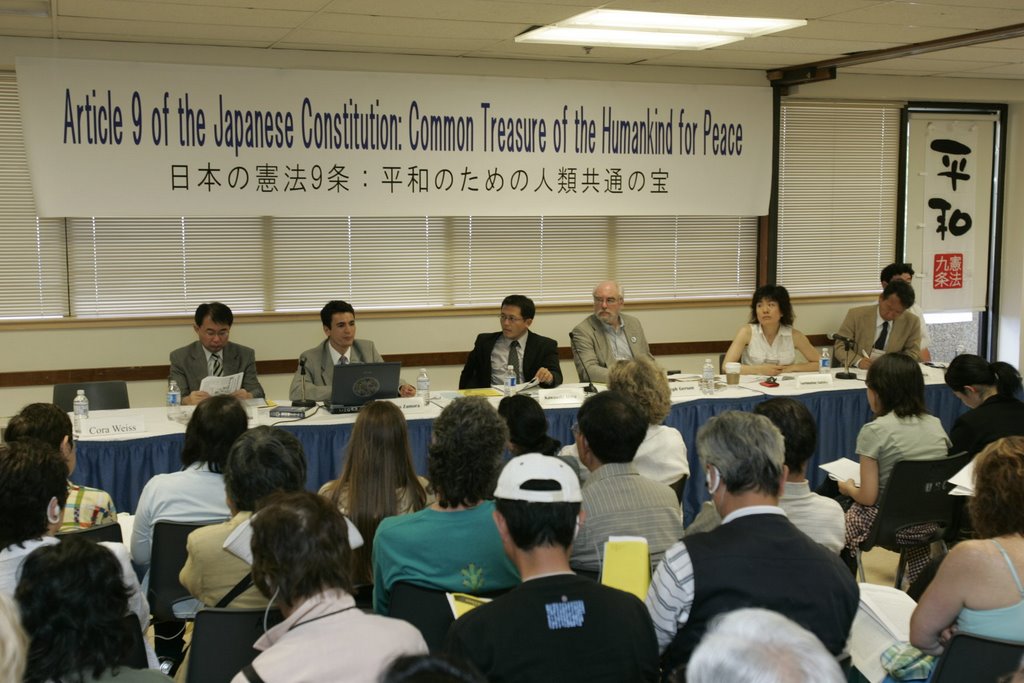 On June 26th afternoon, the workshop 'Article 9 of the Japanese Constitution: Common Treasure of the Humankind for Peace' was held at UBC or the University of British Columbia (photo by Peace Boat), sponsored by Peace Boat, Hague Appeal for Peace, VSA9, Gensuikyo , Gensuikin and Hidankyo. I shared the panel with the 6 other speakers who gave different perspectives on how the Peace Clause of the Japanese Constitution should be upheld and utilized throughout the world for the survival of the human kind and this earth. There were more than 200 people in the audience, and I was honoured to present VSA9, its people and activities at such a significant international conference. The detailed report of the event by the moderator Akira Kawasaki of Peace Boat can be found on the website of the Global Article 9 Campaign.
On June 27th evening, VSA9 hosted a party with World Peace Forum delegates from Japan at Floata Seafood Restaurant in the Chinatown in Vancouver Downtown. Our reserved space was packed with 180+ people including guests from the local peace communities and other international delegates of the Forum. One of the highlights of this event was the presentation of Kinuko Laskey's bust by Keith Shields (photo by JALISA) to the Japanese delegates, with the prospect that Kinuko's bust will find a permanent home in Hiroshima. Kinuko was a Hiroshima A-Bomb survivor who married Canadian David Laskey, and dedicated the last 20+ years of her life educating people throughout North America about the horrors of nuclear bombs. She passed away in 2004, and David Laskey (far right in the photo), who always supported Kinuko's peace activities, has succeeded her cause.
 On the last day of the Peace Forum, Peace Boat came to Vancouver with its one thousand passengers and hosted a series of events for the Forum. I participated in the noontime program 'Travelling the World, Changing the World - People to People Diplomacy onboard Peace Boat' with speakers including Peace Boat's founder Tatsuya Yoshioka and Hague Appeal for Peace's Cora Weiss. What stood out for me in those speeches were Yoshioka's comment about ships as effective vehicle for connecting people and Weiss's stress on education and the role of women for creating world peace.
 The World Peace Forum concluded with Vancouver Appeal for Peace, which included a recommendation for constitutional renunciation of war with Japan's Article 9 as an example. In the photo is the performance by the young passengers of Peace Boat at the Forum's Closing Ceremony in front of Vancouver Art Gallery, which was followed by an evening peace walk from the Gallery to Canada Place where the very last event of the Forum was held - 'Bon Voyage' to Peace Boat.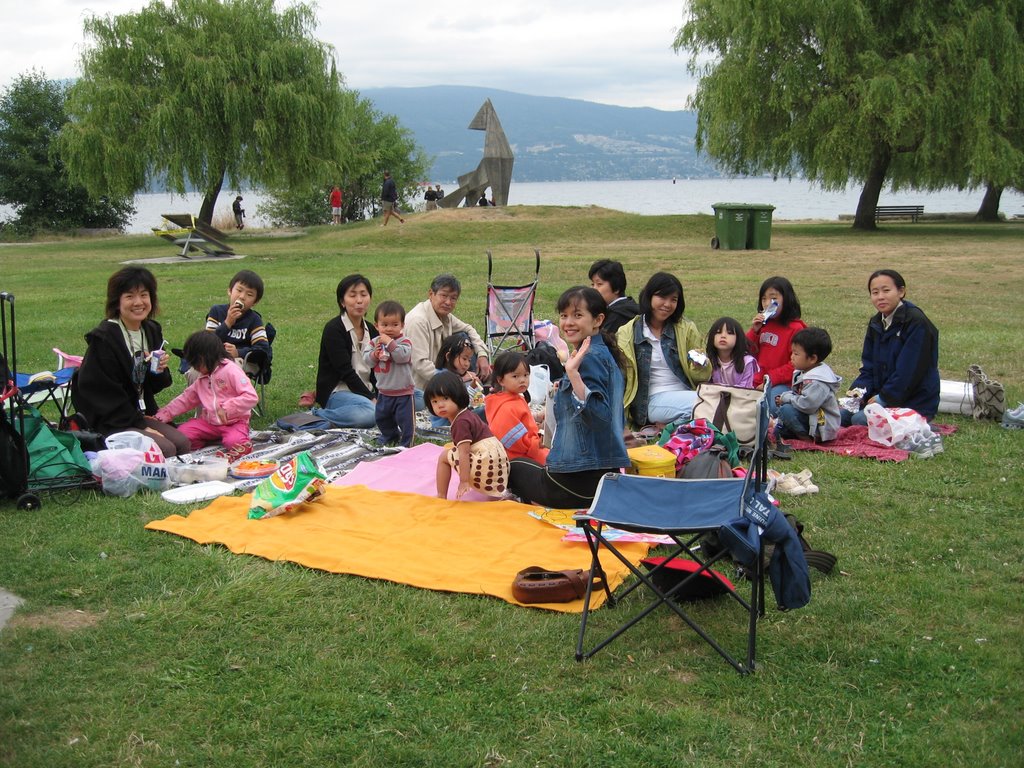
Here is a picture from the VSA9 picnic that celebrated the World Peace Forum success, at the Spanish Banks Beach in Vancouver. This is a perfect picture of peace - people of all ages being safe and happy, smiling, enjoying food and beautiful environment.
We must create a world where this is a reality for all people.
My heartfelt thanks to all that shared the incredible experiences of the Peace Forum.
With lots of love and the best wishes for the new year,
Satoko
Subscribe to:
Posts (Atom)