Showing posts sorted by relevance for query where is okinawa going. Sort by date Show all posts

Monday, December 06, 2010

Where is Okinawa Going? Forum at Okinawa University on December 19 フォーラム「沖縄はどこへ向かうのか?」12月19日 於 沖縄大学 

Notice of a public forum in Okinawa:


Forum:

Where is Okinawa Going? 

*** This forum will present and discuss Okinawan perspectives on the current situations surrounding the southernmost islands of Japan, amid the ongoing controversy over "Futenma relocation" issue, from three aspects: 1) environment and biodiversity, after the Convention of Biological Diversity (COP10) in Nagoya; 2) regional geopolitics in the wake of the Japan-China conflict over the ship collision near Senkaku/Diaoyu Islands ; 3) Okinawa-Japan-US relationship and the military base issue after the gubernatorial election.

Time and Date: 10 AM - 5 PM, Sunday, December 19

Location: Classroom 3-101, Okinawa University


*** Co-sponsored by Asia-Pacific Journal: Japan Focus and The Institute of Regional Studies, Okinawa University

*** In collaboration with  Okinawa Biodiversity Citizens' Network (Okinawa BD) and Peace Philosophy Centre

*** Conference organizers gratefully acknowledge the support received from the Australian Naitonal University.

*** Free admission. The forum will be primarily run in the Japanese language. Translation from and to English can be provided during the Q and A.

*** For inquiries: Okinawa University Regional Studies Institute (Phone 098-832-5599; emai: chiken@okinawa-u.ac.jp  ) 

*** Inquiries in English can be made at: info@peacephilosophy.com

See below for English translation of the program, and the flyer.

第471回沖縄大学土曜教養講座(日曜版)のお知らせ

沖縄は、厳しい現実を前にして、民主主義への灯を絶やさぬよう努力を続けている島です。このたび、「ジャパン・フォーカス」(ガバン・マコーマック氏ら)の呼びかけに賛同し、①COP10、②「尖閣諸島問題」、③知事選の3大局面にゆれる沖縄の現状を沖縄の市民の視点で捉え、次なるステップをどう踏み出すかを問う公開討論会を開催することになりました。

どうか、万障お繰り合わせの上ご参加下さい。

◆タイトル 

Japan Focus/沖縄大学地域研究所

フォーラム

「沖縄はどこへ向かうのか」


◆日時 12月19日(日)10時~17時

◆会場 沖縄大学 3号館101教室

◆内容 Program

セッションⅠ 10時~ COP10以後の沖縄:「生物多様性」に市民はどう取り組むのか
Session I (10 AM-): Okinawa, after COP10: citizens efforts to protect and promote "biodiversity"

〔キーワード〕環境・生物多様性をめぐる連携と乖離(沖縄、本土)、国際社会への関わり
Keyword: collaboration and division between Okinawa and mainland Japan in terms of environment and biodiversity; involvement with the international community
〔パネリスト〕桜井国俊(沖縄大)、河村雅美(沖縄BD)、吉川秀樹 (沖縄BD)
Panelists: Sakurai Kunitoshi (Okinawa University), Kawamura Masami (Okinawa BD), Yoshikawa Hideki (Okinawa BD)

セッションⅡ 13時~ 「9.7」以後の沖縄:「尖閣諸島問題」を沖縄から問い直す
Session II (1PM-) Okinawa after "September 7": Rethinking "Senkaku issues" from Okinawan perspective

〔キーワード〕「国家間対立化」という問題、民衆交流によるアジアとの共生
Keyword: problem of "inter-national" confrontation; co-existance with Asian neighbours through civic exchange

〔パネリスト〕新崎盛暉(沖縄大)、ガバン・マッコーマック(オーストラリア国立大学)、若林千代(沖縄大)、他調整中
Panelists: Arasaki Moriteru (Okinawa University), Gavan McCormack (Australian National University), Wakabayashi Chiyo (Okinawa University) (others TBA)

セッションⅢ 15時~ 11.28以後の沖縄:知事選後の沖縄はどこへ向かうのか
Session III (3 PM-) Okinawa after November 28: Where is Okinawa going, after the gubernatorial election?

〔キーワード〕日米沖の関係 - 普天間、辺野古、グアム、脱基地と沖縄の自治と自立
Keywords: Japan-US-Okinawa relationship; Futenma; Henoko; Guam; "post-military base" vision; Okinawa's autonomy and independence

〔パネリスト〕佐藤学(沖縄国際大)、島袋純(琉球大学)、宮城康博(元名護市議)
Panelists: Sato Manabu (Okinawa International University), Shimabukuro Jun (University of Ryukyus), Miyagi Yasuhiro (former Nago City Assembly member)


◆主催 ジャパン フォーカス/沖縄大学地域研究所

◆協力 沖縄・生物多様性市民ネットワーク/Peace Philosophy Centre

※聴講無料、事前申込不要。

<問い合せ先>

沖縄大学地域研究所
電 話:098-832-5599
e-mail:chiken@okinawa-u.ac.jp

以下、チラシです。

Saturday, December 26, 2009

A Henoko base is not necessary - a Nihon TV Interview with Mayor of Ginowan (English Translation)

** An updated and improved version of this will be published soon. Please wait for that one if you would like to link or quote from it.

Iha Yoichi, Mayor of Ginowan, appeared in "News 24" of Nihon TV (Nittere) on December 11, 2009. The full text of the interview has been transcribed and translated into English by Peace Philosophy Centre(Dan Aizawa and Satoko Norimatsu). The Japanese version is here. 日本語版はここです。

(For simplicity and clarity purposes, some of the questions by the interviewer have been omitted or integrated into the answers by Mayor Iha. )


English translation of the Interview with
the Ginowan City Mayor Iha Yoichi

News 24, Nihon TV, aired on December 11, 2009
  • Question: As the mayor of Ginowan City, you have to deal with the Futenma Marine Corps Air Station. As mayor you have advocated that the Futenma Base is the world’s most dangerous base and that it should be removed from Ginowan. But you have advocated for the complete removal of the Futenma Base from Okinawa Prefecture, and move it all to Guam. What have you discussed with Tokyo, in regards to this matter?
Iha: I met with the Parliamentary Secretary for Defense Nagashima Akihisa, and I also met with the Vice-Ministers for the Ministry of Foreign Affairs and the Cabinet Office, and I have made my demands. The Futenma problem has really become a problem for the government, but we have mainly focused on the issue of whether or not to move the base to Henoko, in Okinawa. However, the US government has already been writing up plans to move the Futenma Marines to Guam, and the Japanese government has spent $6 billion to help fund the plans.

Regardless of this, the Japanese people, parliament, and the people of Okinawa have never been given a proper explanation of the plans. In the US, a report on the environmental impact of the relocation of the base to Guam has been made public; I want this report to be explained in detail in Japan. I want to request that the problems surrounding Henoko and US bases within Okinawa Prefecture be reviewed. I want to ask why a base is still required in Henoko when most of the Marines in Okinawa are being relocated to Guam, and the Futenma Base itself is going to be moved to Guam.
  • Question: Is a complete relocation to Guam possible? Defense Minister Kitazawa has stated that a complete relocation of facilities to Guam would be impossible; this is different from what you have been advocating. What do you think about the Defense Minister’s comments?
Iha: In the “Roadmap” agreement between the US and Japan (United States-Japan Roadmap for Realignment Implementation), in June of 2006, Futenma’s air capabilities were to be relocated to Henoko, but there was no agreement on relocating the Marine units in Futenma to Henoko. However, just half a year before that agreement was reached, until October of 2005, the agreement (U.S.-Japan Alliance: Transformation and Realignment of for the Future) was that the Marine units would also be relocated to Henoko. But in May of 2006, the US Department of Defense changed their plan and decided that all Marine units in Okinawa would be relocated to Guam.

It is public knowledge that 8,000 Marines will be relocated to Guam from Okinawa, and 9000 of their family members will also be moved to Guam. But the number of the family members is less than 9,000. It is said that it is actually less than 8,000. .

The Japanese government has agreed to build homes for 9,000 family members in Guam. Ultimately the Marine units that will be relocated to Guam will be met with more Marine units from around the world. In the end there will be 10,600 marines going to Guam.
  • Question: Is Defense Minister Kitazawa wrong in that sense?
Iha: What Mr. Kitazawa is saying is about moving Futenma’s air facilities to Guam, and how this does not match with the previous US-Japan agreement. Under the current US-Japan agreement, Futenma’s replacement facilities were to be built in Henoko, but we are not talking about the Marine units when we talk about Henoko, but the airbase facilities.

In regards to moving the airbase however, building a new airbase in Henoko and building a new airbase in Guam are two completely different stories. There are already two airbases in Guam, so it should be impossible to build another. But the reason behind wanting to build an airbase in Henoko was because the first agreement had decided that the Marine units would also be moved to Henoko that is why we agreed to build a new base in Henoko.
  • Question: So why did Defense Minister Kitazawa make a trip to Guam now? What did he want to see in Guam? Don’t you think maybe he went to Guam to see whether or not it would actually be possible to completely relocate US troops in Okinawa to Guam?
Iha: According to the former agreement, the 2005 agreement, only the headquarters for the Marine units would be moved to Guam. The actual combat-ready units would not be moved. This is what the government has explained. Much of the debate regarding the relocation has been based on this information. However, this is a debate surrounding the agreement up to October of 2005, and the situation changed afterwards. Under the 2005 agreement, the headquarters of the III Marine Expeditionary Force were to be moved to either Guam or Hawaii. At that point, there were no talks on relocating any of the other Marine units to Guam.

However, by May of 2006, the US Military had warmed up to the idea of relocating troops to Guam; following this the US Military decided to move all 8,000 marines in Okinawa to Guam. This plan was devised in July of 2006, and we have read the document behind this plan, and it is called the Guam Integrated Military Development Plan. Environmental impacts of this Plan have been examined for the past three years, and on November 20, 2009, EIS/OEIS (Environmental Impact Statement/Overseas Environmental Impact Statement) documents have been released.

  • Question: What do you think about Defense Minister Kitazawa’s recent actions and statements?

Iha: We learned some new things from recent events. We learned that the US Marine presence in Okinawa is a strictly tactical post. This means that up until recently the Marines in Okinawa were there so that they could be deployed anywhere. However, this center is now going to be moved to Guam. A small contingent of troops will remain in Okinawa, but this will be for Okinawa alone, and will not be for redeployment to other areas. In the past US troops would be posted to Okinawa and then they would be redeployed to places like Iraq and elsewhere. Okinawa was the center for deployment of troops, but by 2014 troop deployment capabilities will be moved to Guam entirely.

Everyone is thinking about the October 2005 argument, including the media. In other words, everyone thinks that only the headquarters will move to Guam, and that the Marines will stay in Okinawa. However, this is a mistake. I think Defense Minister Kitazawa, by going to Guam, has understood this mistake clearly. He must have had such briefing there. I am pretty sure that he has been informed of the change in the position of Okinawa, though we need to ask him really to be sure. We now understand that the troops in Okinawa are there for tactical reasons, and not strategic reasons.

The official number of US troops in Okinawa is 18,000; however, there are only 11,000 US troops in Okinawa at the moment. From those 11,000 troops, 8,000 will be relocated to Guam. So in the end no more than 3000 troops will be left in Okinawa. However, the Japanese government claims that 10,000 Marines will remain in Okinawa. That gap between 3,000 and 10,000 troops will not be buried. If there’s only going to be a little over 10,000 troops in Guam, how are there going to be another 10,000 troops in Okinawa at the same time?

  • Question: After listening to you speak it has become clear that both Defense Minister Kitazawa and Foreign Minister Okada both lack critical information. How do you think the Japanese government has dealt with this issue so far?

Iha: The biggest problem about this issue is that the US side has failed to explain in detail the Guam relocation plan. There has been no detailed explanation about the situation after the May 2006 “Roadmap,” regardless of the fact that the situation has changed considerably since then.
The Guam Integrated Military Development Plan was set up, and in 2007 the mayors of Okinawa’s central municipalities went to Guam. In Guam, the Okinawa mayors, myself included, were given detailed explanations on where the Marines from Okinawa will go, where the Futenma helicopter units will go, and we were given a detailed explanation on the locations of each of these.

On September 15th, 2008 the US Secretary of the Navy presented, to the House of Representatives, a detailed document on the relocation of troops; particularly on the relocation of so-and-so marine units to Guam.

In June of 2009 the Commandant of the US Marine Corps presented, to the US Senate Committee on Armed Services, a detailed document on the 8,000 marines that will be relocated to Guam. This document assessed the situation of Futenma, and how Futenma had become encroached by local residents and is now located in a highly populated area. The document assesses the problems surrounding Futenma, and the reasons for relocation.
However, the shift in the situation from May 2006 to November of 2009 has not been explained in Japan; it has not been explained in the Diet, and the government has not explained it to the Japanese people.

  • Question: Why don’t the problems surrounding relocation of the base make any progress, why hasn’t the problem been solved yet? Is there an individual or a group that is slowing down the progress; does the Japanese government not want change, or is it the US, or is it the people of Okinawa? Who is slowing down the progress?

Iha: The people of Okinawa are highly opposed to relocating the base from Okinawa simply to another area in Okinawa. It has been 64 years since the war, and 13 years ago, in 1996, there was an agreement. At that time, there was a base relocation plan with a possibility of its removal, but that was rejected. The people of Okinawa are highly opposed to constructing anymore new bases. Okinawa Prefecture comprises just 0.6% of Japan’s land mass, and yet 75% of Japan’s US military instillations are located in Okinawa. The people of Okinawa will not accept a resolution to this problem, where the resolution involves having to remove a base simply to have it restored in another location. , This is unacceptable. This is the greatest opposition, and this is why an inter-prefecture relocation has been opposed so strongly.

  • Question: Is the reason why the Japanese government has been dragging this for so long the strong opposition by the people of Okinawa? Do you think there is maybe some issues over concessions, maybe some parties with interests in the bases?

Iha: That has been said a lot by the media, but we are not debating from that vantage point. However, it has been the government’s position that the U.S. military bases are a necessity under the Treaty of Mutual Cooperation and Security, and the government assumed from the beginning that these bases would be in Okinawa. . In other words, the reason why Henoko was chosen, under the previous LDP government, was because it was decided that there would be no other place but Henoko to build a new base and there would be no alternatives in the rest of Japan; in this way the opinions of the people of Okinawa have been trampled upon.

  • Question: Regarding the Environmental Impact Statement from November 2009, on Relocating Marines from Okinawa, you have concentrated on a particular section entitled “Global Alternatives Analysis Summary” (Page 69, Volume1), which rates the candidate locations using three criteria. Could you explain this for us?

Table 1. 4-3. Global Alternatives Analysis Summary (see the Page 69 of this document for the table)

Iha: The reason why it was decided to relocate the Marines from Okinawa started in 2002, when the US began a global realignment of bases. Within this larger picture Okinawa’s Marines were also included and where they should be relocated. When looking for candidates for a replacement location for Okinawa, Guam got top scores, three stars, as a possible candidate for relocation. In fact, Okinawa only got one star.

I am not the one saying that the US should relocate to Guam; it is the US military that is saying that Guam is the best location for relocation. The “Roadmap” has been agreed upon this decision on Guam by the US.

I don’t know if the Japanese government has been given a proper explanation on this US stance on Guam, but regardless of this, the US will go through on its decision to relocate to Guam. Relocating to Guam from Futenma is not to solve the Futenma Problem, but it is part of a larger US strategic military decision. Under my understanding, I believe that the US will begin large scale relocation of Marines from Okinawa to Guam by 2010.

  • Question: So all of this has been released by the US military? So it must not be just you who has looked through and analyzed these documents; the important people from MOFA and MOD must have gone through these documents, and they must have analyzed and reached the same conclusion as yours?

Iha: The problem is that the bureaucrats from MOFA and MOD have not seen these documents. This is the strange thing about Japan. The Japanese government has agreed to spend over $6.9 billion for this relocation, but the Japanese government doesn’t understand the details of this plan, they do not have enough information to make an intelligent decision.

Last week I met Foreign Minister Okada, and he says he has never heard of what I told him. Okada claims that he has not heard from the US about the Environmental Impact Statement, and has not heard about the things I’ve been telling him. So even after I told him, he claims that what I am saying is wrong; he claims that it’s probably wrong. But because I have been presenting about the Environmental Impact Statement and the Guam Relocation, Mr. Okada has decided to reassess what is the correct information, and what is really going to happen.

What Mr. Okada understands is that there are 18,000 Marines in Okinawa. (This number is only the capacity, not the actual number.) There are only 7,000 Marines in Okinawa right now, but Mr. Okada believes that there will be 10,000 Marines remaining in Okinawa (after relocation of 8,000 Marines to Guam). This is what the US has explained to Mr. Okada. So Mr. Okada has no understanding of any other plan, but the one that he has been told. He does not think that Marine’s operational units (in addition to the headquarters) will go to Guam.
This misunderstanding has been going on for the past three years. This plan to relocate to Guam was decided in July of 2006, and the documents were uploaded onto the US Pacific Command homepage. We downloaded this document, translated it, and we analyzed and explained what it was about. This document was the Guam Integrated Military Development Plan.

The detailed plans of relocating to Guam from Okinawa have already been decided three years ago. For example, there is a section on the relocation to Anderson Airbase in Guam, and there are detailed explanations on the exact locations, on the airbase, of where the Marines from Okinawa will be placed. In fact there are detailed explanations on which part of this new base development will be paid for by the Japanese government. This plan has been around for three years, and it was made available to the people of Guam. The US government shared this document with the people of Guam, received all kinds of feedback and comments, and after all this was done the Environmental Impact Statement was made public in November of 2009, after three years of assessing the situation in Guam. If all goes according to plan, this plan to relocate to Guam will be approved by July 30th of 2010.

So it has already come down to the point of actually assessing the plan, and it is no longer about making the plan. Japan has already decided to pay 30 billion yen on the relocation construction, and the US will pay more than $300 million, bringing the total to about 70 billion yen. This allocation of funds has been decided for the 2010 fiscal plan, so construction will begin in 2010. The first units from Okinawa will begin relocating to Guam in 2010 as well. At first it will only be the command elements, but starting from 2010, and then through 2011, 2012, 2013, and 2014 all units from Okinawa will be relocated to Guam.

  • Question: But the current situation seems to suggest that all these plans may be scratched in the near future?

Iha: No, that is not possible. That will not happen.. The US has decided, not to solve the Futenma Problem, but has decided to build a Marine base in Guam as part of their global strategic plans, and that means that the Marines in Okinawa will be relocated to Guam.
I believe that when information about scratching the plan comes out, it is actually a threat to actually proceed on constructing a base in Henoko. Relocation to Guam will not be scratched. This is because in July, relocation to Guam has already been decided by a treaty, the Guam Treaty. According to this treaty, Japan has agreed to pay $6.9 billion for the relocation; to this the US has agreed to pay $4 billion for the relocation plan and to go through with it. However, construction of a base in Henoko has been completely left out of these talks. It has been revealed in the Diet, that these proceedings do not mean that the US will be obliged to get out of Futenma, but regardless of this the US continues to proceed with its plans on Guam.

  • Question: Do you have anything you must say to the Japanese government?

Iha: I want the government to give a detailed explanation on the relocation to Guam. Japan has agreed to spend a huge sum of money for the relocation, and yet the Japanese government has failed to make a detailed explanation of the relocation plans. The biggest reason for this is because the US government has failed to inform the Japanese government. I want the Japanese government to pressure the US government to give a detailed explanation.

I want an explanation on what kind of units from Okinawa will move to Guam, and I want to know in what form these units will be relocated. After making the above clear the Henoko issue should be reassessed - whether building a base there is really necessary. I believe that there is no need for a base in Henoko.

I believe the information should be revealed to the Japanese people and the Diet. I believe this is the responsibility of the new Hatoyama Government, and that the Hatoyama Government should not proceed with constructing a base in Henoko. I want the Hatoyama Government to solve the Futenma problem and to deal with the relocation of Marines from the whole Okinawa without building a base in Henoko.

  • Question: I get an impression that you are speaking on behalf of all Okinawans, not just as Mayor of Ginowan City, which has Futenma Air Base in it. Have you thought about running for the Okinawa Governer’s election, which will take place in November 2010?

Iha: That is a separate issue. A lot will happen between now and then, but right now I want to focus on solving the Futenma problem.

Saturday, January 01, 2011

Forum "Where is Okinawa Going?" Report フォーラム「沖縄はどこへ向かうのか」報告


Session I on "After COP10" - from right, Kawamura Masami,
presenter, Sakurai Kunitoshi, discussant, and Yoshikawa Hideki,
moderator. Kawamura and Yoshikawa are leaders of the Okinawa
Biodiversity Citizens' Network, one of the organizers of the Forum 
 
Forum "Where is Okinawa Going?" was successfully held on December 19th at Okinawa University. It was attended by 175 people.

Below are related documents.

1)Okinawan newspaper Ryukyu Shimpo's report of the event, from the Internet version and from their December 20th paper issue with English translation

2) Co-sponsor Japan Focus' coordinator and speaker of the second session Gavan McCormack's article on Ryukyu Shimpo on December 14 (see the English version of the article HERE)

3) Co-organizer Peace Philosophy Centre's Norimatsu Satoko's article in Okinawa Times on December 16 (there is no English version but this article is a summary of Norimatsu's reflection on the November 28 Okinawa gubernatorial election - see this LINK -  and the subsequent dialogue with Doug Lummis - see its Part I and Part II)


Session II on Senkaku. At front, from left, Wakabayashi
Chiyo, Arasaki Moriteru, and Gavan McCormack.

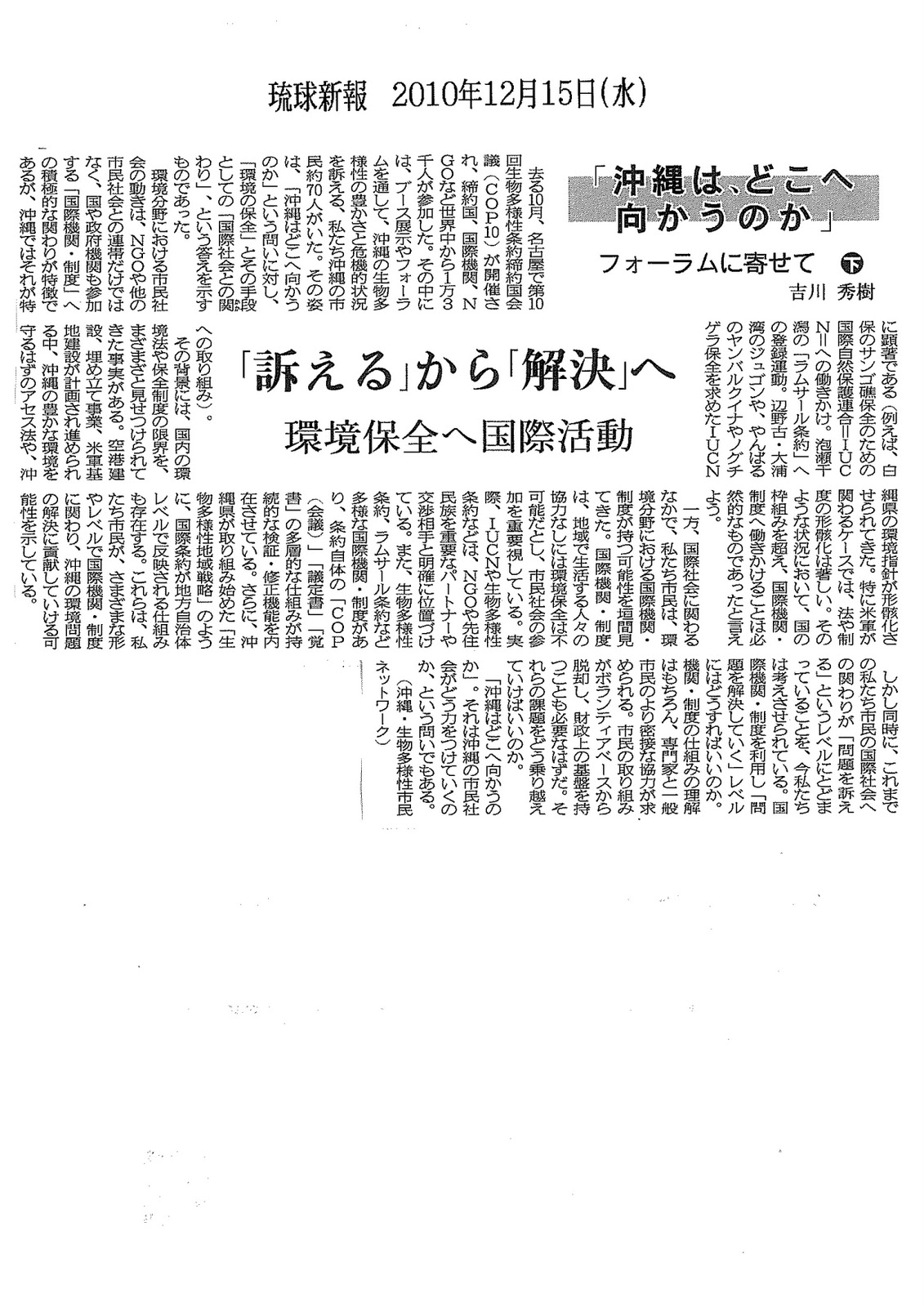
4) Co-organizer and moderator of Session I (COP10) Yoshikawa Hideki's article in Ryukyu Shimpo on December 15 (Japanese)

5) Co-organizer and presenter of Session 1 Kawamura Masami's article in Okinawa Times on December 14 (Japanese)

6) a presentation summary of Kawamura Masami  (Session 1, COP10), from Session I on COP10 (English)

7)a presentation summary of Sakurai Kunitoshi (Okinawa University), from Session I on COP10 (English)

8)Speaker of the second session Arasaki Moriteru's article in Ryukyu Shimpo (in Japanese) on October 4, 2010, on the Senkaku Islands issue, and


Session III on post-election Okinawa. From left,
Sato Manabu, professor of Okinawa International
University and moderator, Miyagi Yasuhiro, and
Shimabukuro Jun.

9)Moderator of the Session II and associate professor of Okinawa University Wakabayashi Chiyo's article on the Senkaku issue in Okinawa Times (in Japanese) on October 2, 2010 (Japanese)

10)Gavan McCormack's interview article in Ryukyu Shimpo on January 4, 2011. The interview was held on the day after the forum, in Naha. (Japanese)

11) Okinawa University's report of the forum and summary of feedback by participants

12) USTREAM Links by Okinawa Alternative Media (Session I, II, III)


1)

琉球新報報道(12月20日)
東アジアの懸け橋に 沖大でフォーラム、沖縄取り巻く課題議論
Report in Ryukyu Shimpo, December 20

2010年12月20日

 「沖縄は、どこへ向かうのか」フォーラム(ジャパン・フォーカス、沖縄大学地域研究所主催)が19日、那覇市の沖大で開かれ、約100人が訪れた。尖閣諸島問題と沖縄、知事選後の沖縄、COP10以後の沖縄の三つのテーマで識者が議論を交わした。Forum "Where is Okinawa Going?" was held at Okinawa University in Naha City, co-sponsored by Asia-Pacific Journal: Japan Focus and Okinawa University Regional Studies Institute. About one hundred attended. Speakers presented their opinions on three themes: the problems surrounding Senkaku Islands, Okinawa's direction after the November 28 gubernatorial election, and Okinawa after COP10. (Translator's note: see this LINK for the outline of this forum, including the program. Also, the organizer's official count of the attendants was 175.)

 尖閣諸島問題を沖縄の視点で問う討論では、新崎盛暉沖大名誉教授が「『固有の領土』論でなく、『生活圏の論理』で見るべきだ」と提唱。ガバン・マコーマック豪国立大名誉教授は「ナショナリズムの波にのまれず、(諸国をつなぐ)万国津梁のビジョンを持つべきだ」と主張した。During the session on Okinawa's perspectives on Senkaku Islands, Arasaki Moriteru, professor emeritus of Okinawa University stressed on the need to look at the Senkaku area as "a place of livelihood for Okinawans" rather than from the national narrative of "Japan's inherent territory."

 知事選後の沖縄を考える討論では、これまでの沖縄振興や基地受け入れによる名護市の振興策を検討。2012年に期限が切れる沖縄振興計画のポスト振計の在り方を模索した。The session on "Okinawa after the gubernatorial election" assessed the "Okinawa Development Program," the existing government subsidy programs including the subsidies for Nago in exchange for hosting military bases. It sought for alternative economic models after the current Okinawa Development Program expires at the end of 2011.

島袋純琉大教授は、「米軍が上で、憲法が下という現状を見極めなければならない」と述べて、沖縄から民主国家の在り方や、自治を変えていく必要性を強調した。Shimabukuro Jun, professor of University of Ryukyus pointed out that the current reality has it that Ampo (US military in Japan) overrides the Constitution and this situation must be re-assessed and changed by seeking new ways of democracy and autonomy for Okinawa.
 宮城康博元名護市議は「(名護は)この間何一つ潤わず、基地建設の容認にもなっていない。ポスト振計は県民主体で作る必要がある」と強調した。Miyagi Yasuhiro, former Nago City Assembly member pointed out that Nago never prospered under the past subsidy programs linked with hosting bases, and residents have rejected hosting a new base.  He stressed that Okinawa's new development plan must be created by Okinawans themselves.

 COP10以後の沖縄に関する討論では、桜井国俊沖縄大学教授らが「生物多様性」への市民の取り組みについて話し合った。In the session on "Okinawa after COP10," speakers, including Sakurai Kunitoshi, professor of Okinawa University, exchanged views on Okinawan citizens' involvement in promoting biological diversity in the region. (Translator's note: see Sakurai's presentation summary in English below.)

Ryukyu Shimpo on December 20, paper version:
2) Gavan McCormack, in Ryukyu Shimpo, December 14


3) Norimatsu Satoko, in Okinawa Times, December 16
4) Yoshikawa Hideki, in Ryukyu Shimpo, December 15

5) Kawamura Masami, Okinata Times, December 14


6) Kawamura Masami's Presentation Summary

Session 1 Okinawa Post COP10

How should Okinawa‘s Citizens address and engage in/with biodiversity issues regionally, nationally and internationally?

Dr. Masami Kawamura (Citizens’ Network for Biological Diversity in Okinawa)

This presentation is an analysis of the Okinawa Citizens’ Network for Biological Diversity’s experience of preparing for and participating in the 10th Conference of Parties, Convention on Biological Diversity (COP10), held in Nagoya, October 2010. Based upon the analysis, it also attempts to suggest what is needed for civil movement in Okinawa.

1. Different Actors, Different Engagements in/with COP10

1) Japanese Government (The Ministry of Environment and the Ministry of Foreign Affairs)


They did not make sufficient effort to get citizens involved in COP 10: they maintain that that COP10 is an inter-governmental conference and policy-making mechanism.

2) Okinawa Prefecture

 Passive attitude toward COP10.
 Okinawa Prefecture is also reluctant to get citizens involved in their projects.

3)-1 NGO Japan Civil Network for Convention on Biological Diversity(JCN-CBD)

It was established as an umbrella organization in January 2009 to form the foundation for Japanese NGOs and Japanese civil society as Japan is the host country of COP10.

-2 Other NPO/NGOs

They were unsatisfied with Japanese Government’s attitude for COP10.

4) Business sector

They regarded COP10 as their new business chance and were concerned with restriction on business practice.

TEEB (The Economics of Ecosystem and Biodiversity)
ABS (Access to genetic resources and Benefit Sharing)

5) Media

They tended to emphasize conflicts over biological resources (e.g. ABS ) between the advanced countries and the developing countries.

2. Difficulties of Citizen’s Engagement in/with CBD/COP10

-Word itself “biodiversity”: Seibutsu Tayosei sounds “difficult and unfamiliar”

-Issues ranging from scientific arena (conservation of biodiversity) to political and social matters (CBD matters including global south, human rights, gender, indigenous people, access to genetic resources and benefits sharing)

-Access to up-to date information (language, tools)

3. How did Okinawa’s citizens address and engage in/with COP10?

1) Citizens’ Network for Biological Diversity in Okinawa (Okinawa BD)

-Established in July 2009 in anticipation of COP10

-It consists of environmental, peace and human rights NGOs/NPOs and concerned citizens.

-Their three core principles are “Environment” ”Peace” ”Human Rights”

- Okinawa BD regarded US Base presence and ill-advised development or “Ran Kaihatsu” as two major causes for the loss of biodiversity.

-Since they have been disappointed at domestic laws and systems as tools for their struggle to stop the US base construction and destructive development projects, they expected international communities to put pressure on Japanese Government to change their polities.

  2) The Okinawa BD is an unprecedented social movement in Okinawa in following   points.

①Okinawa BD is the first network which, with a formal organizational structure, covers environmental, peace and human rights group and concerned citizens in both Okinawa and mainland. The formal structure was necessary and required to participate in COP10.

②It is the first experience that a lot of ordinary citizens were constantly involved in activities, preparing for an international conference for about one year.

③It is also the first time that Okinawa and NGO/NPOs in mainland worked onthe same project, COP10, simultaneously.

3) Activities

-Advocacy (Public comments on biodiversity policy, petition for designation of blue coral reef in Oura Bay and Okinawa Natural Monument, petition for construction conservation of Awase Tidal Flat, Open letter on the construction plan of US helipad in Takae to Okinawa Defense Bureau)
-Building Networks (Attend UNEP workshop)
-Public awareness and education/outreaching (photo exhibitions on biodiversity, field studies, knowledge café)

-Addressing establishment of “Okinawa Regional Biodiversity Strategy”


(Basic Biodiversity Act encourages local authorities to establish the strategy.

Civil participation is a key idea in the process of designing the effective strategy)

4) Projects during COP10

-Booth, poster session
-Position paper
-Pamphlet on biodiversity in Okinawa, booklets
-Symposium and forum
-Appeal to international communities (NGOs, International Indigenous Forum on Biodiversity)

4. Challenges and Possibilities for Civil movement in Okinawa

〜What we learned from the experience of COP10

1) Region

[Challenge]

-Problem of “politicized” biodiversity / “plastic word” “biodiversity”
Criticism and distrust from scientists 
No space for agriculture, fisheries
Lack of perspective of community development

2) National

[Challenge]

-Acquiring skills and building networks to work on same issues.

[Possibilities]

-Sharing Okinawa’s experience of addressing biodiversity issues
(Regional Biological Diversity Strategy)
-Providing input to the biological policies from Okinawa

3) International

[Challenge]
-Review our position and strategy in international community

indigenous people? islanders? scientific experts? 
-Building networks for regional and international community

5. Conclusion (tentative)

-Make use of experience of COP 10 to reflect our movement
-Critical analysis of civil movement in Okinawa is needed.

(There is already great work of analysis of civil participation in Aichi Expo)

-Take the process of establishing Okinawa Regional Biological Strategy as an opportunity to reflect our movement

Seek a new style for dialogue with local authorities and citizens

Acquire new skill for building network for national and international community

Launch channels to people who have not connected us, including scientists, producers.

7) Sakurai Kunitoshi's summary

Session I

Okinawa after COP10

How Do the Citizens of Okinawa Deal with “Biodiversity”?

Beyond the Symptomatic Therapy

(Beyond the “Whack-a-mole”)

1. Background of Symptomatic Therapy

- In Okinawa we are experiencing the rush of public work projects which are carried out as the compensation of the military base construction projects. Therefore, the rush of EIAs for these projects is observed and many of them are of problematic quality. There are also many project proponents who try to sneak out of EIA procedure. That is the reason why we have to implement symptomatic therapy.

Examples of Problematic EIAs: Henoko MCAS, Takae Helipads, Awase Landfill, Shin-Ishigaki Airport, Forest Roads Construction in Yanbaru, New Runway Construction in Naha Airport

- In COP10 Nagoya, Okinawa BD Network emphasized the importance of three issues (Environment, Peace and Human Rights) as a package. This approach was not shared with NGOs in mainland Japan because they are blind to other issues but the environment. But the approach of Okinawa BD Network is more universal and reflects the reality of many less developed countries where not only the biodiversity (environment) but also people’s peaceful life are damaged irreparably by unfair trade with industrialized countries. To protect environment, we have to deal with these three issues as a package.

-  Although the approach of Okinawa has been so far symptomatic, it has clarified the rich biodiversity of the sea of Henoko and Ohura Bay driven by the necessity to criticize the EIA conducted by the Ministry of Defense.

2. Beyond the symptomatic therapy

- In Japan, Okinawa will be the area that will suffer the most from the damage of biodiversity and global warming. The issues of biodiversity and global warming should be treated as a set at least in Okinawa because global warming will damage the biodiversity in both marine and terrestrial environments. However, neither the local government nor the people of Okinawa have sense of crisis. It is clearly shown by the delay in the formulation of local strategy for the conservation of BD as well as the loose goal for the control of green house gas emission.

-  Lack of local strategy allows the proliferation of rampant development projects that are causing irreversible damage to the environment of Okinawa.

3. Three in One Approach is Needed

- If we want to conserve the valuable nature of Okinawa, then we have to listen to the voices of its users such as farmers, fishermen and foresters. Many failures take place because we are deaf to their voices. We have to take a win-win approach combining three components of CONSERVE, USE and KNOW the environment together. We tend to emphasize the component of CONSERVE only.

-  The local strategy for the conservation of BD should be formulated and implemented through the partnership of governments, businesses and civil society. In that sense it is crucial to overcome government’s compartmentalized public administration. If the Nature Conservation Section is left alone to bear this mission in the prefectural administration system, then the strategy will become a flash in the pan.

- New law should be fully exploited. “Law for the Promotion of BD Conservation Activities at Local Government Level through the Partnership of Various Stakeholders” was issued on December 10, 2010.

8) Arasaki Moriteru, in Ryukyu Shimpo, October 4


9) Wakabayashi Chiyo, in Okinawa Times, October 2


10) Gavan McCormack, Ryukyu Shimpo, January 4, 2011

11) Summary of feedback by participants

12) Webstreaming on Okinawa Alternative Media

If below does not work, try these links:
Part I http://www.ustream.tv/recorded/11514314
Part II http://www.ustream.tv/recorded/11517753
Part III http://www.ustream.tv/recorded/11520194


Part I


Part II

Part III 


Monday, March 07, 2011

Anger Spreads Over Kevin Maher's Derogatory Comments on Okinawans ケビン・メア 沖縄蔑視発言に怒り拡がる(英文原文)

Kevin Maher
報道されているケビン・メア氏の発言の英語原文(学生のノートをもとにしたもの)です。(赤字の部分は、メア氏が事実誤認しているところを訂正しているもので、このブログのオーナーが追加したものです。)日本語での報道は、共同のものを一番下に貼り付けました。琉球新報、沖縄タイムスなどにも特集記事がたくさんあるので見てください。英語原文のPDF版はこちらです。

On December 3, 2010, Kevin Maher, Director of the Office of Japan Affairs and former U.S. Consul-General of Okinawa gave a lecture to the fourteen students of American University (Washington, DC) who were going to visit Okinawa to learn about the issues surrounding US military bases there. Kyodo News Agency, Okinawan newspapers Ryukyu Shimpo and Okinawa Taimusu, and other media reported it on March 7, 2011, and anger quickly spread through Okinawa over Maher's numerous derogatory remarks about Okinawa and its people. The March 8 edition of Ryukyu Shimpo ran almost five full pages of special reports, analyses, an editorial that calls for dismissal of Maher, a response from US Embassy in Tokyo saying Maher's views did not represent the US government at all, and critical comments from former Governor of Okinawa Ota Masahide, citizens, politicians and scholars in Okinawa and Japan. Ota says Maher is one who "endorsed the Henoko plan, so we should use this opportunity to crush the plan."

Here is the original text of Maher's lecture, based on the notes that the AU students took then.

Note: PeacePhilosopher added corrections to factual errors in the lecture in red, italic and bolded letters.  See the PDF version without annotation HERE.


United States Department of States Briefing

December 3rd, 4pm, at the Department of State

Participants

-Department of State:
Mr. Kevin K. Maher, Director of the Office of Japan Affairs


-American University:
14 Members of Alternative Break Trip to Okinawa, Japan, Winter Break 2010, "U.S. Military Bases and Their Impacts in Okinawa, Japan"


Presentation

***All opinions and claims are from Mr. Maher

  • I was the Consul General in Okinawa until 2009. It is said that a half of U.S. bases in Japan is located in Okinawa, but the statistic only includes bases used exclusively by the US Military. If all bases, US bases and bases jointly used by the US and JSDF, are considered, the percent of bases in Okinawa is much lower.  (75% of military bases in Japan  exclusive to US use are in Okinawa.)
  • The controversial bases in Okinawa were originally in the middle of rice fields, but are now in the middle of towns because Okinawans allowed urbanization and population growth to surround United States facilities. (US military acquired many of those lands by forceful expropriation or while local residents were in the concentration camps during and after the war. Many residents had no place to live when they returned from the camp, and lived around the bases, close to their home land and where their anscestors' tombs were)
  • The US bases in Okinawa exist for regional security. The Japanese obligation under the US-Japan security treaty is to provide land for bases. The relationship between Japan and the US under the security treaty is asymmetric and benefits the Japanese to the detriment of the US.  (This is contradictory to Maher's last statement, "The high host nation support the Japanese government currently pays is beneficial to the US.We’ve got a very good deal in Japan.")  Japan is not obligated to defend the United States if US forces are attacked, but the United States must defend and protect Japan’s people and property.
  • Collective security is not a constitutional issue, but a policy issue. (Yes, it is a constitutional issue. The Japanese government's interpretation of Article 9 holds that Japan is NOT allowed to use its right of collective self-defense.)

  • Eighteen thousand (18,000) US Marines and an air wing are stationed in Okinawa. (The number in 2007 was 13,200 according to Okinawa Prefecture. The number of Marines in Okinawa at any given time is a lot lower, with many of them in Iraq/Afghanistan and training elsewhere in Asia.) The United States needs bases in Okinawa for two reasons: bases are already there and Okinawa is an important geographical location. 
  • (While showing a map of East Asia) US Forces Japan is headquartered in Tokyo and is the location of a logistics hub that would coordinate supplies and troops in the event of a crisis. Misawa, an important base in the Cold War, is the closest U.S. base to Russia and the base at Iwakuni is only 30 min from Korea, yet Okinawa’s geographic location is important to regional security.
  • Okinawa was an independent Kingdom paying tribute to China, although it has never been a part of China. The U.S. occupied Okinawa until 1972.
  • The Okinawan people’s anger and frustration is directed at Japan rather than the United States.The DPJ government does not understand Okinawa.  The Japanese government does not have a “pipe” of communication to Okinawa. When I offer to contact people in Okinawa DPJ officials say “Yes! Yes, please!” The LDP communicated with Okinawa and understood Okinawan concerns better than the current DPJ government.
  • One third of people believe the world would be more peaceful without a military. It is impossible to talk with such people.
  • The 2009 election brought the DPJ to power, which was the first change in the government of Japan.Hatoyama was a leftist politician. Despite the DPJ and PM Hatoyama, the US and Japan managed to issue the 2+2 statement in May.
(Mr. Maher left the room and two his colleagues gave a lecture about the US-Japan economic relationship. Mr. Maher returned to resume his lecture and the two officials left the room.)

  • The US will relocate 8000 Marines from Futenma to Guam in order to reduce the US Military footprint on Okinawa. The plan will allow the US to maintain a military presence in the region to provide regional security and deterrence capability.
  • Under the Roadmap, Japan will provide money for the relocation and it is a sign of a tangible effort from Japan. The DPJ government has delayed implementation, but I am confident that government will implement the existing plan. Tokyo needs to tell the Okinawan Governor, “if you want money, sign it [agree to the relocation plan].” ]

  • There is nowhere else to base US Marines. The DPJ suggested a replacement facility in mainland Japan, but there is no place in mainland Japan for the US Military.
  • Japanese culture is a culture of "Wa" (harmony) that is based on consensus. Consensus building is important in Japanese culture. While the Japanese would call this “consensus,” they mean “extortion” and use this culture of consensus as a means of “extortion.” By pretending to seek consensus, people try to get as much money as possible. Okinawans are masters of “manipulation” and “extortion” of Tokyo.
  • Okinawa's main industry is tourism. While there is an agricultural industry, the main industry is tourism. Although Okinawans grow goya, other prefectures grow more than Okinawa. Okinawans are too lazy to grow goya (Okinawa is the number one producer of goya, or bitter melon, in Japan, with a share of 33%, followed by Miyazaki's 17% and Kagoshima's 14%).
  • Okinawa has the highest divorce rate, birthrate (especially out of wedlock) and drunk-driving rate due to Okinawa’s culture of drinking liquor with high alcohol content.
  • You should be careful about “tatemae and honne” while in Japan. Tatemae and honne is the “idea that words and actual intentions are different."  While in Okinawa, I said MCAS Futenma “is not especially dangerous." My statements caused Okinawans to protest in front of my office. Although Okianwans claim MCAS Futenma is the most dangerous base in the world,they know it is not true. Fukuoka Airport and Osaka Itami Airport are just as dangerous (Fukuoka and Itami airports are NOT US military bases).
  • Japanese politicians do tatemae and honne all the time. Okinawan politicians will agree to a negotiation in Tokyo but return to Okinawa and claim they did not. The US Ambassador and other representatives to Japan are constantly criticized for speaking the truth because the Japanese culture is too focused on tatemae and honne.

  • The US Military and JSDF have different mentalities. The US Military trains to prepare for possible deployment, but the JSDF train without actually preparing for deployment. 
  • Local people oppose to night training by the US Military but it is necessary because modern warfare is often fought at night. Night training is essential to maintain deterrence capability.
  • I don’t think Article Nine of the Japanese Constitution should change. I doubt it will ever be changed. It would be bad for the United States if the Japanese Constitution was changed because Japan would not need the United States’ Military. (The US military bases are justified under Anpo, or the Japan-US Security Treaty, NOT Article 9 of the Japanese Constitution. The Japanese Constitution does NOT stipulate anything on US military presence in Japan.) If the Japanese Constitution was changed the United States would not be able to use Japanese land to advance US interests. The high host nation support the Japanese government currently pays is beneficial to the US.We’ve got a very good deal in Japan.
******* the end of notes of Maher's lecture on December 4, 2010 *******
Related news below.

The Japan Times
http://search.japantimes.co.jp/cgi-bin/nn20110307a2.html


Monday, March 7, 2011

U.S. diplomat accused of disparaging Okinawans
Islanders 'masters of manipulation and extortion' on Futenma issue

Kyodo News

A U.S. official in charge of Japanese affairs at the State Department is said to have likened the Japanese cultural principle of maintaining social harmony to "extortion" and described Okinawans as "lazy" during a speech in Washington late last year.

According to a written account compiled by students who attended the lecture at the State Department, Kevin Maher, head of the Japanese affairs office and a former consul general in Okinawa Prefecture, described Okinawan people as "masters of manipulation and extortion" when dealing with the central government.

"I am not in a position to comment on the record at this time," Maher said, noting his briefing was an off-the-record event. He said the account made available to Kyodo News is "neither accurate nor complete."

Maher has been involved in the bilateral negotiations on relocating the U.S. Marine Corps Air Station Futenma and is known to be an advocate of relocating it elsewhere in the prefecture, an idea detested by local residents.

The remarks attributed to Maher are making waves.

They are "racially discriminating against Okinawa," said Teruo Hiyane, a scholar on postwar Okinawan history. Ukeru Magosaki, a former diplomat, said Maher's reported view on Japan is "biased and completely distorted."

Maher gave the speech Dec. 3 at the request of American University to a group of 14 students who were about to embark on a roughly two-week study tour of Tokyo and Okinawa.

In the speech, Maher was quoted as saying, "Consensus building is important in Japanese culture. While the Japanese would call this 'consensus,' they mean 'extortion' and use this culture of consensus as a means of extortion.

"By pretending to seek consensus, people try to get as much money as possible," he said.

Maher also criticized the people of Okinawa as "too lazy to grow 'goya' (bitter gourd)," a traditional summer vegetable in the prefecture, according to the account.

On the base, which is situated in a crowded residential area of Ginowan, Maher allegedly said that while Okinawans claim the base is the most dangerous in the world, they know it's not true.

The civilian airports in Fukuoka and Osaka are "just as dangerous," he reportedly said.

Maher was quoted as saying that the Japanese government "needs to tell the Okinawan governor, 'If you want money, sign it," referring to the Futenma relocation plan.

Students who took notes during Maher's speech said he definitely made the remarks, and at least one said it was surprising to hear statements full of bias coming from a person in the U.S. government.

The air base affair in Okinawa has been dragging on for well over a decade.

Maher, 56, served as the consul general in Okinawa from 2006 to 2009 after joining the State Department in 1981 and being posted to Tokyo and Fukuoka.

Maher said of the account provided to Kyodo that he "cannot control how individual students themselves might interpret remarks" and "it would therefore not be appropriate" to attribute any specific remarks to him "based upon secondhand information coming from students or others."

In the summer of 2008, while he was posted in Okinawa, Maher sparked controversy after questioning why the local authorities were allowing the construction of homes in the residential area around the Futenma air base. Plaintiffs seeking damages over noise from the U.S. base then presented him with a written demand calling on him to immediately leave Okinawa.

Magosaki, former head of the international intelligence office at the Foreign Ministry, said he had the impression that "U.S. officials in charge of recent U.S.-Japan negotiations shared ideas like those of Mr. Maher," adding "in that sense, his remarks were not especially distorted."]

*******************************

Kyodo News, March 7, 2011

Okinawa governor dismayed by U.S. official's 'extortion' remark


NAHA —
http://www.japantoday.com/category/national/view/u-s-diplomat-said-to-have-likened-japanese-idea-of-harmony-to-extortion

Okinawa Gov Hirokazu Nakaima expressed dismay Monday at a remark made by a former U.S. consul general in Japan’s southwestern island prefecture describing people there as ‘‘masters of manipulation and extortion.’‘

‘‘His remarks make me question what the U.S. consular office in Okinawa exists for,’’ Nakaima told reporters. ‘‘I wonder what he learned in Okinawa when he was here.’‘

Former Consul General Kevin Maher, who is in charge of Japanese affairs at the U.S. State Department, talked about his experience of negotiating with Japan over the relocation of the U.S. Marine Corps’ Futenma Air Station to Nago, another location in the prefecture, which is stiffly opposed by Okinawa citizens.

Maher told Kyodo News, ‘‘I am not in a position to comment on the record at this time,’’ saying his briefing was an off-the-record event. He said the account made available to Kyodo News is ‘‘neither accurate nor complete.’‘

The remarks attributed to Maher are being seen as provocative in Japan. They are ‘‘racially discriminating against Okinawa,’’ said Teruo Hiyane, a scholar on postwar Okinawan history. Ukeru Magosaki, a former Japanese diplomat, said Maher’s reported view on Japan is ‘‘biased and completely distorted.’‘

Maher spoke on Dec 3 at the request of American University to a group of 14 students just before their roughly two-week study tour to Tokyo and Okinawa.

In the speech, Maher was quoted as saying, ‘‘Consensus building is important in Japanese culture. While the Japanese would call this ‘consensus,’ they mean ‘extortion’ and use this culture of consensus as a means of extortion.’‘

‘‘By pretending to seek consensus, people try to get as much money as possible,’’ he said.
Maher also criticized people in Okinawa as ‘‘too lazy to grow ‘goya’ (bitter gourd),’’ which is a traditional summer vegetable in the southern prefecture, according to the account.

On the Futenma base, located in a crowded residential area of Ginowan, Maher allegedly said while Okinawans claim the base is the most dangerous in the world, they know that is it not true.

Civilian airports in Fukuoka and Osaka are ‘‘just as dangerous,’’ he reportedly said.

Maher was quoted as saying that the Japanese government ‘‘needs to tell the Okinawan governor, ‘if you want money, sign it,’’ in reference to the Futenma relocation plan.

Students who produced notes of Maher’s speech said he definitely made the remarks, with at least one saying it was surprising to hear statements full of bias from a person with a position in the U.S. government.
Maher, 56, served as consul general, the top U.S. envoy, in Okinawa from 2006 and 2009 after joining the State Department in 1981 and being posted to Tokyo and Fukuoka.

Maher said of the account provided to Kyodo that he ‘‘cannot control how individual students themselves might interpret remarks’’ and ‘‘it would therefore not be appropriate’’ to attribute any specific remarks to him ‘‘based upon secondhand information coming from students or others.’‘

In the summer of 2008, while he was posted in Okinawa, Maher sparked controversy after questioning why the local authorities were allowing the construction of homes in the residential area around the Futenma base. Plaintiffs seeking damages over noise from the U.S. base presented him with a written demand calling on him to immediately leave Okinawa.

Magosaki, former head of the international intelligence office at the Foreign Ministry, said he had the impression that ‘‘U.S. officials in charge of recent U.S.-Japan negotiations shared ideas like those of Mr Maher,’’ adding ‘‘in that sense, his remarks were not especially distorted.’‘

Hiyane, professor emeritus of the University of the Ryukyus, said he ‘‘cannot overlook’’ remarks describing Okinawans as ‘‘lazy’’ and ‘‘masters of manipulation and extortion,’’ adding Maher’s remarks represent ‘‘a blatant mentality of occupation.’‘

‘‘The U.S. military has for over 60 years after the war occupied land best fit for agriculture in Okinawa,’’ he said. ‘‘Were it not for U.S. bases, the local economy including agriculture would have been different.’‘
‘‘By pretending to seek consensus, people try to get as much money as possible,’’ he was quoted as saying.

He also described people in Okinawa as ‘‘masters of manipulation and extortion’’ in their relations with the central government, according to the account.

In Tokyo, top government spokesman Yukio Edano told a news conference, ‘‘I do not think it is necessary to verify every remark (made by a U.S. official) based solely on news reports,’’ noting that their two countries regularly discuss and share mutual understanding on a wide range of bilateral issues.

Edano made his remark when asked if the government would make inquiries with the United States about the matter.

*****************************
Kyodo News, March 8, 2011
http://www.japantoday.com/category/politics/view/u-s-says-it-is-aware-of-okinawa-base-hosting-burdens-respects-local-people
U.S. says it is aware of Okinawa base-hosting burdens; respects local people

Tuesday 08th March, 08:42 AM JST

WASHINGTON —
The U.S. government is aware of the base-hosting burdens in Japan’s Okinawa Prefecture and respects the local people, a U.S. official said Monday, following recent reports that said a State Department official is said to have made remarks disparaging the people.

‘‘We recognize the burden that the people of Okinawa bear in terms of our bases. We deeply appreciate that,’’ a State Department official told reporters on condition of anonymity.

‘‘We have a great deal of respect for Okinawa and its people,’’ the official added.

His remarks came after Kevin Maher, who heads the Japanese affairs office at the State Department, is said to have made offensive remarks about Japanese culture and people in Okinawa in a lecture to students in Washington late last year.

The unnamed official declined to confirm or deny Maher’s remarks, saying only, ‘‘I’m not going to comment on things that may or may not be accurate.’‘

He also said Washington will continue to work with Tokyo on the relocation of a key U.S. Marine base in the southern island prefecture.

Maher likened the Japanese cultural preference for maintaining social harmony to ‘‘extortion’’ and described the people on the southern island of Okinawa as ‘‘lazy,’’ according to a written account compiled by some students who attended the lecture.

以下、共同通信による日本語報道。
2011年03月06日
和の文化「ゆすりの手段」 
 沖縄は「ごまかしの名人」
  メア米日本部長が発言 

 米国務省のメア日本部長(前駐沖縄総領事)が昨年末
、米大学生らに国務省内で行った講義で、日本人は合意
重視の和の文化を「ゆすりの手段に使う」 「沖縄はごま
かしの名人で怠惰」などと発言していたことが6日まで
に分かった。
 メア氏は米軍普天間飛行場(沖縄県宜野湾市)の移設
問題など日米交渉に実務者として深く関与、移設先を同
県名護市の辺野古崎地区とした現行案決着を米側で強く
主張してきた人物の一人。発言は差別的で、日本と沖縄
への基本認識が問われる内容だ。
 講義を聞いた複数の学生がメモを基に作成した「発言
録」(A4判3ページ)によると、メア氏は「日本の和
の文化とは常に合意を追い求める」と説明したうえで「
日本人は合意文化をゆすりの手段に使う。合意を追い求
めるふりをしながら、できるだけ多くの金を得ようとす
る」と述べた。
 沖縄については、日本政府に対する「ごまかしとゆす
りの名人」「怠惰でゴーヤーも栽培できない」などと発
言。普天間飛行場は「(住宅地に近い)福岡空港や伊丹
空港と同じ」で特別に危険でないとし、日本政府は仲井
真弘多(なかいま・ひろかず)・沖縄県知事に「お金が
欲しいならサインしろ」と言うべきだと述べている。
 メア氏は共同通信の取材に、講義は「オフレコ(公開
しないこと)で行った」とし、発言録は「正確でも完全
でもない」としている。
 講義は米首都ワシントンのアメリカン大の学生ら14
人に対し、彼らが東京と沖縄へ約2週間の研修旅行に出
発する直前の昨年12月3日、大学側の要請で行われた。
 講義録を作成した学生たちは「メア氏は間違いなくこ
のように言った」と証言。「米政府の地位ある人物の偏
見に満ちた言葉にとても驚いた」「人種差別的発言と感
じた」などと話している。(共同通信編集委員 石山永
一郎)

メア日本部長の発言要旨 

 米国務省のメア日本部長の発言要旨は次の通り。
 海兵隊8千人をグアムに移すが、軍事的プレゼンス(
存在)は維持し、地域の安全を保障、抑止力を提供する
。
 (米軍再編の)ロードマップのもとで日本は移転費を
払う。日本の民主党政権は実施を遅らせているが、私は
現行案が実施されると確信している。日本政府は沖縄の
知事に対して「もしお金が欲しいならサインしろ」と言
う必要がある。ほかに海兵隊を持っていく場所はない。
 日本の文化は合意に基づく和の文化だ。合意形成は日
本文化において重要だ。
 しかし、彼らは合意と言うが、ここで言う合意とはゆ
すりで、日本人は合意文化をゆすりの手段に使う。合意
を追い求めるふりをし、できるだけ多くの金を得ようと
する。沖縄の人は日本政府に対するごまかしとゆすりの
名人だ。
 沖縄の主産業は観光だ。農業もあり、ゴーヤー(ニガ
ウリ)も栽培しているが、他県の栽培量の方が多い。沖
縄の人は怠惰で栽培できないからだ。
 日本に行ったら本音と建前について気を付けるように
。言葉と本当の考えが違うということだ。私が沖縄にい
たとき、「普天間飛行場は特別に危険ではない」と言っ
たところ、沖縄の人は私のオフィスの前で抗議をした。
 沖縄の人はいつも普天間飛行場は世界で最も危険な基
地だと言うが、彼らは、それが本当でないと知っている
。(住宅地に近い)福岡空港や伊丹空港だって同じよう
に危険だ。
 日本の政治家はいつも本音と建前を使う。沖縄の政治
家は日本政府との交渉では合意しても沖縄に帰ると合意
していないと言う。日本文化はあまりにも本音と建前を
重視するので、駐日米国大使や担当者は真実を言うこと
によって批判され続けている。
 (共同)

発言録は正確でない 

 ケビン・メア米国務省日本部長の話 学生たちにはオ
フレコ(公にしないこと)で講義を行った。彼らが私の
発言をどのように解釈し、ノートにとったかまでは関知
し得ないが、学生からの2次的な情報をもとに、特定の
発言を私の発言とするのは不適切だ。発言録は正確でも
完全でもない。(共同)


ゆがんだ対日観を共有か

 孫崎享(まごさき・うける)・元外務省国際情報局長
の話 偏見であり、あまりにもゆがんだ日本観だ。日米
安保条約に基づく日米関係では日本は基地を提供、米国
は安全を保障するという対等かつ相互が利益を得る関係
のはず。日本は他国と比べても多額の「思いやり予算」
を払っており、「ゆすり」などとんでもない。普天間飛
行場の危険を軽視している点も日米が危険を認識したう
えで進めている移設計画の大前提を否定しているかのよ
うだ。
 ただ、メア氏のような考えを最近の日米交渉にたずさ
わる米側担当者が共有している雰囲気はあった。その意
味では発言が突出してゆがんでいるとは思えない面もあ
る。

看過できない差別発言 

 比屋根照夫(ひやね・てるお)・琉球大学名誉教授(
沖縄戦後史)の話 メア氏の発言は赤裸々な「占領意識
」そのものであり、沖縄に対する人種差別発言だ。米軍
は沖縄の最も農業に適した土地を戦後60年余りも占拠
し続けている。基地がなければ農業を含めた経済のあり
方も変わってくる。その現状を無視して、沖縄の人間を
「怠惰」「ごまかしとゆすりの名人」などという発言は
看過できない。米軍統治下でさえこれほどの侮蔑的な沖
縄観は表明されなかった。辺野古への基地移設案が動か
ない現状へのいら立ちが、図らずもメア氏の心底にある
沖縄蔑視を露呈させたのではないか。一方、それを記録
し、告発した米学生らの意識の高さに感銘を覚える。


ケビン・メア氏略歴 

 ケビン・メア氏 1954年生まれ。81年、米国務
省入省。在日米大使館安全保障部長、駐福岡米領事など
を経て2006年~09年まで駐沖縄米総領事。
 総領事時代の08年夏、普天間飛行場周辺に住宅地が
密集する状況について「なぜ市が建設を許しているのか
疑問がある」と発言、普天間爆音訴訟の原告らから「即
刻、沖縄から退島するよう」求める決議書を手渡された
。09年4月には総領事館近くのコーヒー店で男に突然
コーヒーをかけられる被害を受け、沖縄県警が男を逮捕
している。
 帰米後も国務省日本部長として日米の実務者協議など
の際にたびたび来日している。東大客員研究員の経験も
あり、日本語が堪能。