Showing posts with label Peace From Within. Show all posts

Tuesday, February 19, 2013

日本人の倫理を問う: 松元保昭

もうすぐ311原発事故が始まって2年になる。当サイトに重要な記事を投稿してきてくれた松元保昭氏が投稿してくれたエッセイは、振り返る暇もなくこの悲惨な事故を追ってきた私たちを一時立ち止まらせ、人間性の深淵へいざなう。怒りと苛立ちと涙と絶望を、無数の顔知る人知らぬ人と共にしてきた。3年目の入り口に立って、松元氏が提起する失われた倫理回復への道―「裁き」と、真摯な反省、謝罪、補償を経た自然回帰―への歩みは始まっているのか、と自問する。少なくとも、自分が小さくともその過程の一部になるかならぬかの選択肢はない、と自覚する。@PeacePhilosophy

 
日本人の倫理を問う

2013214

松元保昭

▼はじめに―嘘と責任
子どもが嘘をついたら、どんな親でも叱るだろう。学校の先生も、やはり嘘をついた生徒を叱るだろう。私は教師だったころ、万引きをした生徒があらわれるとクラス全員によく灰谷健次郎の「チューインガムひとつ」を読み聞かせたものだ。人格からほとばしり出る灰谷の指導による作品なのだろうが、悔悟の深みにおりてゆく安子ちゃんの素直な心性と、とりわけ罪を犯したわが子に恐懼して嘆く母親の姿に胸を打たれた。他者と自己自身にたいする責任という人としての民衆倫理は、こういうところから形成されるのではないだろうか。
3・11で「文明の病」(石牟礼道子)はさらに深く広がった。原発をめぐるさまざまな事態を見るにつけ聞くにつけ、井上ひさしの「にんげんがおかしくなっていませんか」という声が天から響いてくるような気がしてならない。今の日本では、さまざまな制度の理屈をともなって、嘘と誤魔化しが、無責任と非倫理が横行支配してしまっている。責任者を処罰することもなく、子どもたちとその未来を放射能と誤魔化しで覆うことは、許されないことだ。日本人のモラルの特質と未来について考えてみた。

▼嘘と誤魔化しの現実
この二年間の東電や政府の対応をみると、そのウソには目に余るものがある。最初から情報を正確に伝えないばかりか、事故当初のようにSPEEDI情報の隠蔽や安定ヨウ素剤配布義務の不履行の最中で「ただちに影響はありません」などという言い訳で誤魔化す手法が、その後常套手段になってしまった。例えば飯館村モニタリングポストのように、その地点だけ除染してコンクリートで覆って線量を低くしている策術。75パーセントは山林に囲まれる飯館村はいくら除染しても線量はすぐ戻る。しかし村長は一年以内の住民の帰村を計画しているという。こういう類の制度的誤魔化し、システムによる欺きが行政施策として横行しているのが日本の倫理的現在である。

思いつくままに挙げると、住民被害の最小化を最優先するより原子炉施設と政権の存続を考えた東電と政府の初期対応。その後も一貫している住民のいのちと健康を最優先にしない国と地方の行政姿勢。はなから差別と誤魔化しを制度化している電源三法交付金と総括原価方式。事故責任、賠償責任回避のためのメディアによる巨大な過小評価戦術および人心管理システム。より具体的には汚染線量基準引き上げと海洋、湖沼、河川、山林、および生物濃縮の詳細な被曝線量調査報告義務の意図的不履行。同じことだが自己決定可能な情報提供と補償も賠償もない棄民政策。大地の汚染を無主物と言い張る欺瞞と厚顔。中学生でもわかる食物連鎖と生物濃縮という機制を「希釈」と偽って隠蔽する言説操作の類。希釈拡散禁止という国際合意に反する汚染食品流通やがれき処理の拡散。移染でしかないものを除染と欺き、大手ゼネコンに復興予算が還流する除染や広域がれき処理のシステム。チェルノブイリを超える避難基準の線量引き上げと汚染実態と見合わない区域設定。御用学者とメディアが誘導する一貫した内部被曝の軽視ないしは無視と表裏一体の「安全安心」再誘導、司法もこれに追随。具体的には、放射線核種からの細胞破壊、DNA損傷による心臓疾患、免疫障害、死産、奇形など数多の健康障害の実例を挙げずに、賠償訴訟の困難が目に見えている原因を確定できないがん疾患にのみ特定して「安全」を説く常套戦術。診療せずに「県民健康調査」という誤魔化し。隠蔽のための非診療と非公開。「線量計細工」など無法無権利のまま放置されている大量被曝で使い捨ての原発労働者。活断層など地震の温床を無視する再稼動の準備。事故のない通常稼動でも温排水、放射線核種排出、原発労働の危険性など変わらぬ隠蔽。推進派でかためられた規制庁トップは国民を規制・弾圧する元警察官僚。三基の原発がメルトダウンした史上最悪の惨事が進行中に加え、4号機の使用済み燃料プールが瓦解する一触即発の状況だというのに「収束宣言」。原発の永続化と核兵器の製造可能性に密接に結びついている「すでに破綻している」再処理技術と核燃サイクルへの固執。10万年も100万年も誰も責任など取れないのに、嘘と誤魔化しと欺きの核廃棄物処理、等々。原発を存続させるとしたら、これらの嘘と誤魔化しもまた何十万年も続くことになるのだろう。

圧倒的市民の怒りは、脱原発運動に糾合した。しかし民衆の怒り、「再稼動反対」の叫びは、「脱」原発というエネルギー政策転換の要求をはるかに超えて、蔓延する「嘘と誤魔化しはもうたくさんだ」という民衆の倫理的叫びであった、と私は思う。

これほどの惨事を招きながら誰一人責任を問われず逮捕も処罰もされない法治国家があるだろうか。厳しい責任を問うことこそ、未来への一歩である。現在、東電の事故責任と政府および関係機関の隠蔽・不正の刑事責任を問う告訴・告発が福島原発告訴団によってなされている。またこれに先立って、子どもたちの緊急疎開を求めるふくしま集団疎開裁判も進行中である。脱原発運動とこれらの訴訟が車の両輪となって責任を問い続けることを願っているが、国家責任、企業責任を民衆の立場で裁いてこなかった日本の司法には残念ながら多くを期待できない。事故前から「この国の未来のために、人類の未来のために、原発を止める責任があります」とはじまった脱原発運動が、こんどこそ「責任者の責任を追及する」運動へと深化することを望みたい。チューインガムを盗んでも、他者と自己への厳しい責任追及を果たすことこそ人間になる条件なのだから。

また、日本政府と電力会社が「国際的に合意されている科学的知見」だとして隠蔽と過小評価の拠り所としている国際機関IAEAおよびICRPにも触れなければならない。とりわけチェルノブイリ以降、IAEAおよびICRPによる国策と事業者利益優先の見解およびリスク基準は、内部被曝による多様な健康障害を無視し被害住民に被曝受忍を強制している各国の棄民政策の後ろ盾になっている。これら国際原子力ムラの出先機関は、WHOやUNSCEARの手足を縛り放射線障害の研究および疫学調査を著しく遅滞させ、遺伝子学、分子生物学の知見を無視して、遺伝子、細胞、臓器の各レベル、胎児も幼児も妊婦も同じ平均化数値を「リスク基準」とすることによって、内部被曝によるさまざまな放射線障害の症例を出来させている現実を隠蔽し、受忍強制と棄民政策を放置している。このような、原子力産業を推進し核兵器管理体制を支えている米英仏露など安保理核大国の伏魔殿が控えていることも視野におかなければならない。このIAEAが国際原子力産業のために、いまフクシマの幕引きを画策している。

ついでに言えば、人道支援と民主主義の伝道師、警察官のような顔をしたこの核安保理大国は、最近でもアフガニスタン、イラク、リビア、シリアと内外から武器を供給しては内乱を呼び起こし何十万、何百万人もの人々を虐殺しては避難民に追いやり、国家をぐちゃぐちゃに破壊しても平気である。イラン、北朝鮮へと続かないことを祈る。同時にこれらの核保有管理国は核廃絶を先延ばしにしながら、稼動中の原発427基、建設・計画中も含めると596基の原発を全世界で存続推進しようとしている。ECRRの試算によると、核実験および通常稼動の原発から放出された人工放射能によって、すでに6000万人以上のがん死亡者を生み出しているという。金力と権力を祭壇とする彼らにとって、人のいのちや自然など何の値打ちもない。

▼自然の復権―パチャママ法の実現
故郷を奪われ、焼け石に水の僅かな賠償金で棄民され、誤魔化しの線量基準でモルモットにされている福島県民が、もし、「故郷の自然を守り」自然と共に生きる生業が最優先され、放射性物質や化学物質を排出する自然を汚染する事業は禁じられ、責任者は処罰されるという法律が施行されたなら、「天佑」として歓迎することだろう。

アイヌ民族にしかるべく狩漁権や土地が返還され、旧被差別部落民や貧農や在日朝鮮人に優先的に土地が配分され、琉球人民の独立権が確立し安保条約・地位協定が廃棄されて、米軍基地を日本全国から全面的に撤退させたなら、どれほど多くの人たちが日本という「国」に希望をもつだろう。さらに、敵をつくらず歓待の精神に充ち溢れている先住民族の知恵が生かされて、北朝鮮との国交が樹立され、日本軍「慰安婦」や強制連行被害者はもちろん明治以降の周辺諸国への侵略行為に謝罪と和解と補償の政策が実施されるなら、どうじに戦争責任・戦後責任にかかわる在日朝鮮人・中国人、原爆被爆者、空襲被災者たちと、水俣病など多くの公害犠牲者たちにも同様の謝罪と和解と補償の政策が実施されるなら、そのときこそ日本民族の未来に本当に新しい一ページが開かれることになるのかもしれない。(とうぜん法人税・累進税の大幅変更、最低賃金底上げ、医療および老後の完全保障、労働時間の大幅縮減など制度的住民救済が必須であるがここでは触れない。)

福島原発事故の経験から圧倒的多数の人々は、国家というものは信用ならぬものであり、人間は自然に依存しなくては生きていけないという二つのこと思い知らされた。避難を余儀なくされた、あるいは避難か残留か帰村か棄郷かの逡巡を日常的に強いられている200万の福島県民だけではなく、日本列島に住まうあらゆる人々が海洋、山林、河川、湖沼の汚染の測り知れぬ脅威を前に、いま自然そのものの毀損に懼れ慄いている。

「理性の営みは、地のエレメントの逆襲によって破綻する」とヘーゲルが言ったそうだ。自然を支配することに人間の主体・主権をみたヨーロッパ近代なるものの限界が唱えられて久しい。人間の産業活動、核軍事力をともなう国家活動の制限は各国憲法によってもいまだ道半ばであって、その国家に庇護された資本の自由放任は依然、地球上各地で自然破壊、人権破壊の猛威を振るっている現状だ。

原発は、自然界全体に放射性物質を撒き散らすことによって人間のみならず全生命システムを不可逆的に毀損攪乱する。ことは人間の身勝手な費用対効果(リスクベネフィット、コストベネフィット)論をはるかに超えて、自然とともに生きる人間の基本的なあり方の攪乱と破壊である。世界の最貧国のひとつ多民族国家ボリビアの試みに着目してみたい。

昨年10月、ボリビアのエボ・モラレス大統領は、「パチャママ(母なる大地)法」の施行を全世界に公表した。ひとつの生命体としての「パチャママ」(母なる大地)を神聖なものととらえ、この大地とともに調和して生きる生物の「共通の利益」を最優先にするという立法である。生命とその再生という自然のバランス・システムを擁護するため生物多様性を尊重し、遺伝子組み換え作物は禁じられ、清浄な水と空気の保障、人間活動の影響からの回復、放射性物質や毒性化学物質による汚染からの自由に対する権利などが、「地球(母なる大地)」に与えられることになる。

権利の主体は自然であり、人間活動から自然環境を守ることに法の主眼がある。先住民族の知恵に裏付けられたその哲学は、一言でいえば「人間は自然の一部」であり自然によってこそ「よく生きる」ことができるという原理である。自然を破壊する資本の開発に抗して、自然と調和して「よく生きる」ための「母なる大地法」として提案されたものである。この法案は、20104月にボリビアで開催された「気候変動にかんする世界民衆会議」のために、ボリビアの36の先住民族グループすべてと300万人以上を代表している広範な主要社会運動組織5団体が草案を準備したもので、201112月に議会で承認され、20121015日エボ・モラレス大統領によって公布された。

▼倫理と希求を押し潰してきたサムライ日本
それにしても、これほどまでに嘘と誤魔化し、隠蔽と策術に長けた日本人とは何であろうかと思ってしまう。政府と原子力ムラの意向を最優先に報じるメディアの「大本営発表」はたびたび揶揄されてきたし、科学と科学者の信用を失墜させた御用学者の誤魔化しも白日の下に晒された。こうした奸策は、はたしていつごろから日本人に定着したものなのか。

いまだに「維新」をありがたがる風潮は跡を絶たないが、黒船到来から西南戦争の内乱、そして明治憲法の成立にいたるサムライたちの権力闘争とその民衆統治には姦策が付き物だった。アイヌモシリと琉球の植民地化、江華島事件にはじまる対外侵略の過程では目を覆うばかりの、民衆を虫けらのように犠牲にして怪しまない奸計、姦策、陰謀、謀略の歴史が敗戦まで続く。

これらの姦策、奸計は、敗戦直後の昭和天皇自ら保身濃厚な沖縄無期限貸与発言を含めて、支配層の常套手段であったばかりではない。数多の軍人、官吏、一般市民の卑劣な奸計行為が日本人の他民族支配の本質をなしてきた。その具体的事例は、例えば朝鮮半島支配の実態、強制連行、軍「慰安婦」、関東大震災時における朝鮮人虐殺のデティールを見れば明らかである。帝国軍隊はさながら人殺しの道場のようであったとしても、戦場に駆り出された兵士たちの目に余る蛮行も一人一人の人間が行ったことだし、強制連行も、軍慰安婦の調達、隠匿、使役、その後の隠蔽も、日本人民衆が関わる制度的な奸策なしには為されなかった。戦後憲法制定時の人民規定を「国民」に限定したのも在日朝鮮人排除を念頭においたものであったし、今日の高校無償化不適用の画策にいたるまで、朝鮮人に対する一貫したあの手この手の差別排除の行為は行政権力だけでなくそれに関わる国家・地方公務員および支持する市民の共犯あってのこと。しかもデティールを見れば明らかな姦策、悪巧みを自民族の行為として直視し謝罪したくないものだから、フォーカスをボカしてはついには「なかったことにする」という他者に対する倫理的欺瞞と卑劣さ、ここに日本人の特質があると言わざるをえない。それを覆い隠す象徴的遺物はなんといっても天皇と軍隊と靖国神社であろう。高橋哲哉氏は、靖国=沖縄=福島を犠牲のシステムと呼ぶ。

日本人の倫理を考えるときもっとも困難で重要なことは、いったん民衆から自生した倫理的審査要求が国家形成に継承されることもなく徹底的に押し潰されたことである。幕末からの数多の百姓一揆を引き継いだ自由民権運動から田中正造をへて幸徳秋水に至るまでことごとく弾圧され押し潰され小林多喜二の虐殺に行き着く暗黒の歴史によって、日本人の民衆倫理はついに国家や天皇を超える自立したものにはならなかった。倫理を教導するはずの諸宗教は、ことごとく教義をねじまげて戦争協力になびいた。

ところで武勇を奉るエートスは、維新のはるか昔から和人の表の顔でもあった。神武以来8代の天皇に武がつくという逸話もさることながら、坂上田村麻呂の征夷によって謀殺されたアテルイとモレの話はじつに9世紀初頭の話である。コシャマインもシャクシャインも和合を偽っての謀殺である。秀吉の東北アジア征服構想による鼻塚・耳塚はいまも京都にあるが、クナシリ・メナシ惨殺後の塩漬けの話は知らない人が多い。アイヌの記憶に耳を傾けると幕末のイシカリ浜民族浄化から明治の土人扱いにいたるまで、和人および日本人の卑劣、野蛮、非道は、その後につづく琉球人、朝鮮人、中国人に対しても同様、標本のように並んでいる。西洋に媚を売る新渡戸稲造は武士道を美化したが、「勝つためには手段をえらばず」、敵に打ち勝ち自分の身内一族郎党のためには姦策・謀略何をしてもよいというのが武士道の本義だった。無論サムライはオトコ社会であって、女性は最初から隷属排除されてきた。非倫理の下手人は天皇はじめすべてオトコであった。こうしたサムライのモラルは利益を目指す企業人エートスに接ぎ木され、武勇は受験、スポーツ、企業競争へのエネルギーとして肉体化され身内への集団主義的貢献、保身と栄達のための克己に転化してきた。

そうした国家体制そのものは、敗戦によって清算されたかに見えた。日本国憲法の倫理的自己批判が、このような精神構造を廃棄させたかに見えた。しかし原子力ムラの強固な布陣が見せているのは、国家制度全体が巨大独占資本に乗っ取られているということだ。60年もの自民党支配のもとで網の目のような資本系列に加え中央地方の行政組織が利益誘導の潤滑油となって、ほとんどあらゆる企業、労働組合までもが国策誘導になびくシステムになっている。大は資本の海外進出から小は地域の土建屋まで、どんな小さな企業や組織で働こうとも企業・組織への貢献は国家社会への貢献に連動して無意識化される。だから、無批判な「サムライニッポン」の掛け声が、「絆」がそのまま動員の原動力にもなる。維新によってビルトインされたサムライの魂は、しっかり生きている。

ここでは、個々人の「倫理的重心(魂の重心)」は毎日のメシをあてがってくれる「組織の恩恵」を超えるものであってはならず、それは容易に「国家の恩恵」に拡延されて多くの市民が「国家・組織に依存する個」を脱却できずにいる。こうして組織的隠蔽が正当なものとして扱われ、制度的犯罪、国家犯罪が横行してしまう構造になっているのではないか。オキナワもフクシマも巨大な国家犯罪である。例えば、隠蔽を暴くはずのメディアの報道犯罪をメディア自身が暴くことができない。カネに縛られている地方自治体も住民本位に出来ない。企業や組織に個人の倫理を表現する場はなく、表現したものは組織から排除される。国家の嘘、組織の嘘は、同胞の嘘であって、許容し合うというムラやサムライの倫理が司法の頂点まで残存支配しているように思える。国家・組織に忠誠を尽くし貢献することによって日々の安楽と将来の保障を対価とし受け取る構造は、戦前の一枚岩的な国家主義の構造と基本的には変わらない。朝鮮統治時代や南京虐殺最中の当時の新聞をみると、「安楽全体主義」が粛々と生きていたことがわかる。

こうして対外的な奸計、姦策、陰謀、謀略に対するに、対内的な「国家・組織への忠誠」「仲間への監視」というサムライの倫理パターンが受け継がれてきた。戦前戦後と一貫しているこの倫理無き倒錯は、絶えず武人としての克己振る舞いを正当化することを属性としている。簡単に言うといつも自分を「よい子」に扱っていたがる。この自己正当化は、自民族中心主義の温床となって生きている。

明治以降の他民族支配の歴史をけろりと忘れ責任ある謝罪も賠償もなく「平和愛好国民」と思い込む。かつての「一大家族国家」の残影からすぐに「絆」に「領土防衛」に踊らされる。「組織への忠誠」こそ倫理だと思い込むところから、組織全体が加害者になっていることにも目を塞ぐ。自分自身が加害者の一端を担っているということにも目を塞ぎ心を閉ざす。直近の見本は、がれき処理に反対して不当逮捕された大阪の下地真樹准教授の「学生のみなさんへ」を読めば明らかだ。犯罪を取り締まる警察と検察という組織そのものが犯罪を犯し共犯者を生み出している。組織中心の閉鎖的な視野狭窄世界こそ、島国ニッポンの安楽な居場所となる。

例えば、米国批判の論調にも無意識に「よい子」があらわれている。オキナワにせよ、TPPにせよ、F35にせよ、その都度「日米同盟」への従属が、米国の誘導が指摘される。だが肝心の日本の権力中枢、巨大独占資本の野望と実態はいつも隠されている。日本の中枢の要望無しには果たされ得ないのに。アメリカが悪いのでなく(無論世界に冠たる悪だが)日本人が悪いのだ、とは思いたくない。自己を、身内を、抉ることができない。

こうした組織への忠誠と自己肯定が日本人と日本社会の根底にあって、この土壌の上に排外主義と敵視政策が連綿と続けられてきたといえる。朝鮮学校無償化排除が決定し、このたびの核実験後は、北朝鮮への偏見とバッシングはさらに一層強まろう。(米韓日の核脅迫外交で封じ込め、戦後一貫して足蹴にしてきた事実に頬かむりして倫理無き日本人は怒る。)それに乗じて日本の軍事拡大化に拍車がかかろう。その準備ともいえるあからさまな情報遮断の秘密保全法が危ぶまれている。ハンナ・アーレントは、「国家のドグマを受け容れようとしない者、あるいは何らかの理由から教化の対象から除外されている者すべてに対する、婉曲で間接的な脅迫…ここにはすでに、全体主義テロルの完全に発達した最終段階が顔をのぞかせている」と指摘する。

戦前の対外的な責任を回避する方法は戦争であった。戦後は米国の核の傘のもとで札束で責任を回避し、経済の触手が中東、アフリカ、ユーラシアに広がってきたいま、再び軍事力で解決しようとしているのが倫理無き国家の有様である。過去の遺伝子から容易に全体主義の軍事国家になるだろう。中国だ、北朝鮮だと、絶えず「敵」をつくっては「敵」に立ち向かうサムライ倫理にぴったりと符合する。

しかし心ある日本人の魂は引き裂かれ、「諦め」を乗り越えて魂の安寧を保つことは並大抵ではない。安子ちゃんのように真摯な反省が魂を浄化させ新たな倫理的人格を獲得するという努力は、日本のような社会では容易なことではない。

みなが、「生活」を奪われないために善意を「誤魔化して生きる」生活を強いられる。そんな卑怯な生き方が出来ないものは、結局、企業や組織から一抜けたというところで自然農法などで没社会的に生きるか、家庭と立身を犠牲にして市民運動に飛び込むか、はたまた幸徳や多喜二のように死を賭してでも闘わなければ倫理に忠実に生きることが出来ない、というところに追い込まれているのが、倫理無き国家の民衆の在り様なのではないか。国家から独立した個、国家や組織の向こうにある生身の他者がかかわっている歴史や未来に対する責任という倫理本来の在り方を多くの市民が身に着けることが出来なくなっている。この制度全体を支えている、飼い馴らされ抵抗もしない中心部日本国民の変革無くして、日本民族の未来はむなしい。
いま日本人は、露呈されたこの「どうしようもないオカシサ」の前にたじろいでいる。日本人全体が「ダメになっている」とささやかれている。仮に一人一人がおかしくなくとも、15世紀のヒエロニムス・ボスが描いたように全体の構図においては普通の顔の人々が超現実の地獄絵に収まる世界が呼び起こされる。あるいは我が子を喰らうサトゥリヌスを描いたゴヤが…。

▼希望は自然と共に―責任倫理と民族形成の課題
子どもが外で遊べない、海で泳げない、川遊びができない、野山をかけっこできない、魚や貝が食べられない、食べ物、空気、飲み水、住まい、触れるものすべてがいつも不安だ。人類史上、こんなことがあっただろうか。大地に抱かれていた自然への帰属感が根底から揺らいでいる。

事故後の8月、福島県二本松市のゴルフ場が除染を求めて東電を提訴した。それに対して東電が「無主物」に対する責任は負えないと反論し話題となった。言うまでもなく天然自然には誰も所有者がいないというローマ帝国以来の「無主の地(Terra Nullius)」を逆手に取った責任逃れである。挙証責任を被害者になすりつける卑怯な便法である。

この「無主地」に由来する「先占(Occpatio)」は、世界各地の先住民族を除外し敵視したわずかな国家間の「国際法」となった。自然支配と人間の虐殺・奴隷化・隷属化、さらに人権の剥奪・侵害が必然的に交差している原型は、日本列島でサムライの犠牲となったアイヌを含め世界いたるところの先住民族の記憶に刻まれている。先住民は野蛮人で征服されるべきものというキリスト教起源の観念はシェイクスピアにも正直に描かれている。この、対イスラームにはじまったカトリック、さらにプロテスタント国に引き継がれた大規模な植民地時代が、今日の「近代」をつくった。しかし未知の自然と異民族は神が人間に委託した被造物であり征服支配の対象などとは考えないイスラームは、この「無主地先占」には与しなかった。西洋植民地主義を可能にしたこの地球支配の戦略は、「自然」への身勝手な定義によってヴァリエーションを変えて続いている。すなわち、未知の生命体の知的所有権として、遺伝子組み換えの新しい経済支配として。そして原発と核兵器という核開発による、人工放射線核種を全地球に拡散しても「自然」には所有権がないと責任を回避する方便として、人間と自然の汚染と破壊と収奪は現在も続いている。

今回の「無主物」発言は、はからずも核時代において、数百年も続いてきた植民地主義の継続と資本のグローバリズムが告白されているわけだ。核を軍事と産業の基軸に据えた現代は、科学と技術の限界というよりも資本・国家と結合したそのあり方が限界点に達したと見るべきであろう。

とりわけ自然の恩恵を被ってきた日本は、「公害列島」および「列島改造」によって罰当たりなほどに自然を毀損・破壊してきた民族であって、さらにフクシマ後「放射能汚染列島」にしてしまった罪は途方もなく深く重い。日本の人民は、サムライの夷狄征伐、天皇国家の対外侵略、さらに敗戦後の自然破壊の経済一辺倒という二重三重の過去の非倫理を乗り越えて未来を展望しなければならい。

責任とか倫理とかモラルなどと何と迂遠な話を、とお叱りを受けるかもしれない。しかし倫理とは、過去と未来の歴史を見据えた、たえず現在にかかわる実存的態度決定のことである。決断とは断つことである。

福島の事故後、脱原発へと大きく舵を切ったドイツの倫理委員会共同委員長マティアス・クライナー氏はつぎのように語った。「私はひとりの父親として自問自答しました。大量の廃棄物を生み、巨大事故のリスクを抱えた技術を、利用して良いのだろうか、負の遺産を未来の世代に押しつけることが本当に許されるのだろうか、原発の是非は単なる経済の是非ではなく、倫理の問題として考えるべき課題なのです。」

倫理無き日本にはこうした委員会も委員長も不在であるが、ナチスを生み出したがゆえにドイツには強い知的伝統がある。カール・バルトからボンヘッファーにいたる告白教会の系譜やドイツ敗戦直後の罪責についてのカール・ヤスパースの思索などが背景にあってヴァイツゼッカー演説を導いたことはよく知られている。倫理的責任という応答可能性が、人間の無くてはならない本質だという認識がドイツおよびヨーロッパには根強くある。こういう普遍的言説空間あるいは精神性が社会的に共有されていない、デモや市民運動以外に共有の場がない、というところに日本人の大きな困難性があるといえる。碩学ヤコヴ・ラブキン氏は「みずからの政治について道徳的な問いかけを許容しない社会は必然的に腐敗した社会となる」と警告している。

事故後の日本では哲学者の高橋哲哉氏が、この責任について精力的に語っている。ヤスパースの罪責論を下敷きに、福島原発事故の①刑事上の罪、②政治上の罪、③道徳上の罪について的確に告発している。④番目の形而上の罪とは、通常一神教における「神の呼びかけ」に応答しない罪であるが、日本にも「天の恵み」に感謝する、あるいは反する行いなどの観念が古くからあった。

ユダヤ教、キリスト教、イスラームの一神教の聖書では、人間の織り成す歴史と天変地異に神意をみる格闘が描かれている。こうした伝統にあった人々の「形而上」という観念は、神意を帯びた意味性の領域であった。倫理とは、自然との営み、他者との応接、そして歴史や伝統に自己を位置付ける「意味と応答」をめぐる精神の営みであった。神意をどのように見るかはここでは問わないが、自然と他者とを自分のように尊重する伝統が日本にもあった。

例えば「真の文明は 山を荒さず 川を荒さず 村を破らず 人を殺さざるべし」と説いた田中正造、「森を守る事は人間の暮らしそのものを守る」と説いた南方熊楠、あるいは「循環と調和」というエコロジーを先駆的に説いた安藤昌益のように。そうした際立った達人もさることながら、地域の自然と仲間を守るために立ち上がった無名の農民一揆のダイナミズムに日本人の倫理の根源があるような気がしてならない。戦後も自然と地域の内発性の再発見あるいは森と里の思想など日本の自然と伝統の知恵から近代を超える提言が続けられている。自然の多様性に包まれて生きてきた東アジアモンスーン地帯でこそ、自然の復権に豊かな未来の可能性が潜んでいるのではないか。

ついでに言えば、人類はカメラや自動車を食って生きるわけにはいかない。世界諸民族の生存は、まずもって農水畜産の恩恵なしには立ち行かない。産業革命以降の囲い込まれた工場での賃金労働と投機を主とした「一部文明国」の経済から、自然に帰属し自然と共に歩む「人類史的」な経済が土台にならなければならない。福島事故の最初の犠牲者が、牛と共に生きてきた畜産農家であったことは痛ましくも象徴的な警告である。

日本にも近代法を超えた「母なる大地の法」が施行され、新しい倫理的審査基準をつくって人間と社会を形成し直すべきだ。自然との共生にもとづく人権の再定義が、企業法人の再定義が必要となろう。教科書も大幅に書き変えられよう。それはまた、倫理性を備えた日本民族の未来を選択することでもある。先住民族の世界観の復権をともなって、アイヌ、沖縄および周辺諸国民との和解と共生の道へとつながる。倫理の復権は、自然の復権にあると考える所以である。

私たちは、自然を失ったことの「形而上的な罪」をいまこそ考えなくてはならない。冒頭の安子ちゃんに代わって武藤類子さんが自然を毀損したことの謝罪からはじまる素晴らしい未来への言伝を残してくれた。彼女が、責任者を裁く告訴団の代表であることは心強い。繰り返すが、真摯な反省と謝罪、賠償がなくては、日本人はまっとうな倫理的人間になれない。そのために「裁き」は不可欠の関門である。革命はつづく…。


松元保昭(パレスチナ連帯・札幌)
元高校教師。ここ10年ほど「パレスチナ連帯・札幌」代表として、パレスチナ問題とアイヌ問題を結び付けて北海道で活動。3・11後は、反原発の立場で精力的に情報提供や発言をしている。


Monday, December 24, 2012

Holiday Greeting: 平和の最大の敵は無関心である。戦争の最大の友も無関心である。(阿波根昌鴻) "The biggest enemy for peace is indifference. The biggest friend for war is also indifference." (Ahagon Shoko)


With  Best Wishes for the Holidays・・・

阿波根昌鴻 Ahagon Shoko

沖縄・伊江島の「ヌチドゥタカラの家」に行って欲しい。沖縄戦で息子を亡くし、米軍に暴力的に接収された伊江島の土地を取り戻すため、生涯非暴力抵抗・説得・教育活動に尽くした阿波根昌鴻(あはごん・しょうこう)氏の平和思想を学び行動に結びつけたいThere is a peace museum called "Nuchi du Takara," meaning "Life is Treasure," on Iejima (Ie Island), half an hour ferry ride from the Motobu Peninsula of Okinawa Island, which honours leader of the residents' movement for return of their farm land,  late Ahagon Shoko (1901-2002). After the Battle of Okinawa, much of the farmers' land was forcefully confiscated by the occupying US military, and still today, one third of the island is occupied as the US Marine Corps training ground. Ahagon insisted on non-violent resistance, persuasion, and education, and is known by many in Okinawa and beyond as "Okinawa's Gandhi." To learn more about Ahagon and the history of resistance in Iejima, see below articles: 

--I Lost My Only Son in the War: Prelude to the Okinawan Anti-Base Movement (Ahagon Shoko and Douglas Lummis)

--Beggars’ Belief: The Farmers’ Resistance Movement on Iejima Island, Okinawa (Jon Mitchell)


すべて剣を取るものは剣にて亡ぶ(聖書)
基地を持つ国は基地で亡び
核を持つ国は核で亡ぶ(歴史)
Ahagon's words that signify his philosophy of peace are written on the outside wall of the museum and everywhere in the facility, which also offers accommodation and a lecture room. On the left of the door says "Those who take weapons perish by weapons (The Bible). Those who have military bases perish by military bases. Those who have nuclear weapons perish by nuclear weapons (History)." 

Inside the museum--- clothes worn by those who were victimized by the Battle of Okinawa. It says "We want people who need weapons and wage wars to wear these clothes." 


館長の謝花悦子(じゃはな・えつこ)さんと。後ろは事務局長の山城弘子さん。
(2012年11月26日)
Author (right) with Jahana Etsuko (in the chair), Director of the Museum. At the back is Yamashiro Etsuko, administrator. 


平和の最大の敵は無関心である
戦争の最大の友も無関心である
"The biggest enemy for peace is indifference. 
The biggest friend for war is also indifference."


伊江島はいまだに島の3分の1が海兵隊基地として取られたままである。沖縄戦や戦後の土地接収を経て、もうこれ以上の受難が許される場所ではないのに、2012年10月からさらにオスプレイ訓練が、夜間も含め行われるようになった。
Twelve of MV-22 Osprey were deployed in Okinawa, despite the all-island opposition at the beginning of October 2012 (See also Okinawan's message for US Marine Corps). As if Iejima had not suffered enough, the island is now being used daily for Osprey training, causing intense noise and fear among the residents, of the accident-prone aircraft. 

真謝地区の、米軍基地と隣接した場所にある「団結道場」。1961年に建てられ、「伊江島土地を守る会」の集会場として使われた。
"Danketsu Dojo" (Solidarity Training Centre)built in 1961 and used by Ahagon and his colleagues for return of their land.

今こそ団結してオスプレイの訓練中止、配備撤回をさせなければいけない。無関心を敵とし、平和のために声をあげ、暴力に抵抗し、行動しなければいけない。As Ahagon said, make indifference our enemy, and concern and action our friend. Osprey training must be stopped, and the aircraft must be overall removed from Okinawa. 


阿波根昌鴻氏と伊江島のたたかいについての参考図書

『命こそ宝 沖縄反戦の心』(岩波書店)
『米軍と農民 』(岩波書店)


☆★☆★☆★☆★☆★☆★☆★


今年も当サイトの記事を読んでいただきありがとうございました。
Thank you for supporting Peace Philosophy Centre!

--- Satoko Oka Norimatsu, Director, Peace Philosophy Centre

Monday, February 13, 2012

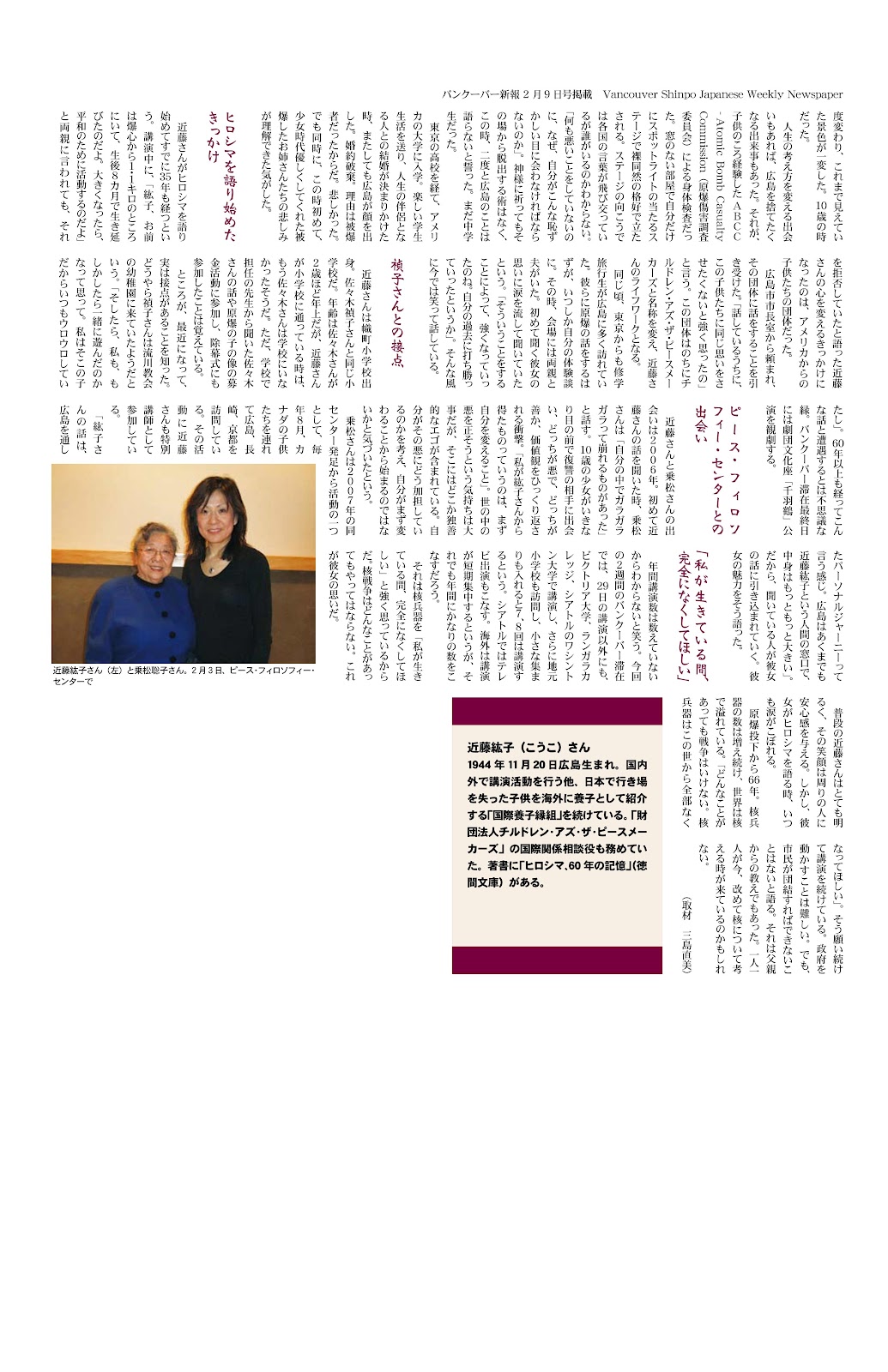
近藤紘子『バンクーバー新報』インタビュー An Interview with Koko Kondo in Vancouver Shinpo

カナダ・バンクーバーの日本語週刊誌『バンクーバー新報』2012年2月9日号に掲載された、近藤紘子さんと、ピース・フィロソフィー・センターへのインタビュー記事を紹介します。転載を許可いただいたバンクーバー新報と、インタビュー、執筆を担当されたライターの三島直美さんに感謝いたします。@PeacePhilosophy

この記事は『バンクーバー新報』オンライン版でも見ることができます(パート1 10,11ページ)。

近藤さんはバンクーバー、ビクトリア、シアトルでの講演の予定を終え、帰途につかれました。彼女のストーリーは、著書『ヒロシマ、60年の記憶』(リヨン社と徳間書店から刊行)でどうぞお読みください。

Monday, February 06, 2012

『月刊ふれいざー』2月号 近藤紘子講演報告

1月29日、バンクーバーユニタリアン教会で開催した近藤紘子さん講演のレポートが『月刊ふれいざー』2月号に掲載されました。『ふれいざー』の許可をいただきここに転載します。紘子さん西海岸訪問の最後の公開イベントは2月7日、シアトルのワシントン大学で行います。@PeacePhilosophy


Sunday, February 05, 2012

Inspiring, empowering, and heartwarming - Koko Tanimoto Kondo will speak at University of Washington, Seattle, 3:45 PM February 7 近藤紘子シアトル講演(於ワシントン大学 2月7日3時45分)


Koko Tanimoto Kondo at a gathering
in White Rock, BC, February 4

"I have had the privilege to travel with Koko and hear her story twice now and have been truly grateful for the experience. She is an exceptionally strong person for sharing and reliving her powerful story year after year. Anyone who takes part in listening to her story will remember it vividly for the rest of their lives as I know I will. Any hibakusha(atomic-bomb survivor)'s tale is something you will never forget and be privileged to listen to, and I hope you will be as grateful to Koko as I am for sharing it yet again."

-- Tammy Mueller, past participant from the Hiroshima/Nagasaki Study Tour of 2010 from Webster University, St. Louis


"Meeting Koko Kondo provided one of the indelible aspects of the American University peace study trip to Japan. The insights she shared about bomb's affect on her life, and the lives of others, stories about her father and the people of Hiroshima, provided all participants something of rare value. Her wisdom, sense of humor, and optimism were deeply moving. I look forward to seeing her again."
Koko speaks at the University of Victoria, BC, January 31
(A Neil Burton Memorial Lecture)

-- John Chappell, professor of history at Webster University, a participant of the Hiroshima/Nagasaki peace tour of 2011


If you would like to hear Koko's talk, this may be the last chance in North America in a while. She will speak at the University of Washington, Seattle, on February 7. See below for details.

*** Koko will appear in the King-5 News in Seattle between 8:30 and 9:00 AM on February 8. Please tune in! ***

 Living with Hiroshima: My Memories of 66 Years

Koko Tanimoto Kondo

Tuesday February 7, 2012

3:45 – 5:00 PM

Communications Building Room 120

 The University of Washington, Seattle, WA

Sponsored by UW Japan Studies Program and the Peace Philosophy Centre, Vancouver B.C.

For more information contact: japan@uw.edu


One of the remaining survivors of the Hiroshima atomic bombing, Ms. Kondo has spent many years working for peace. She has made it a priority to share her perspective on the effects of the bombing that reverberate through her life and the lives of others and to bring a greater understanding of how we can make a difference in the world. Kondo was an infant and 1.1 km away from the hypocenter of the first atomic bomb dropped on August 6, 1945 in Hiroshima, Japan. Kondo, who miraculously survived the bombing, grew up with victims who came to her father’s church on a daily basis. Seeing the terrible scars on people, and the devastation all around, Koko hoped to meet the ‘bad guys’ who did this to them. Then, that opportunity arrived....


For more information on Koko Tanimoto Kondo, see HERE.

@PeacePhilosophy

Monday, January 30, 2012

Koko Tanimoto Kondo in Victoria, BC/Seattle, WA: Living with Hiroshima - 66 Year of Memories 近藤紘子ビクトリア、シアトル講演案内

Koko Tanimoto Kondo's talk at the Unitarian Church of Vancouver was a great success, with a turnout of over 100 and an inspiring musical and mime performance and participation of students who went to Hiroshima and Nagasaki with Koko. Thank you all who planned, participated, and helped, and sent wishes to the event! Professor Roy Tamashiro of Webster University and his colleagues will create a documentary based on the event and a series of interviews that they conduct in Vancouver.

Koko will talk at the University of Victoria on Tuesday, January 31. Below is a flyer.

Note on February 1: Koko's Victoria talk was a phenomenal success, engaging 130 university and community members.  Big thanks to the University of Victoria, Centre for Asia Pacific Initiatives, Neil Burton's family, and Professor John Price, and all who attended the event.

For those who missed the Vancouver and Victoria events, it is not too late... Koko will be speaking at the University of Washington, Seattle, on February 7. See HERE for details.


Saturday, January 07, 2012

A Special Event in Vancouver, January 29, 2012: Koko Tanimoto Kondo, a Hiroshima Survivor 近藤紘子バンクーバー講演「ヒロシマと共に―66年の記憶」2012年1月29日

『ヒロシマ、60年の記憶』(リヨン社、2005年)著者、広島被爆者であり国際養子縁組等で活躍される近藤紘子さんの特別講演をバンクーバーで2012年1月29日に開催します。日本語講演、シアトル講演も企画予定です。(下方11月23日朝日新聞夕刊に載った記事も参照)
The Unitarian Church of Vancouver Adult Education Programme and the Social Justice Committee will present:


Hiroshima A-bomb Dome (Photo by Satoko Oka Norimatsu)


"Living with Hiroshima: My Memories of 66 Years":
An Evening with Koko Tanimoto Kondo
近藤紘子講演(英語)
「ヒロシマと共に生きる:66年の記憶」


6:30 - 9:00 PM, Sunday January 29, 2012

At The Unitarian Church of Vancouver (949 West 49th Avenue, Vancouver, BC - on Oak St.)
Admission by Donation

This event opens with a performance, ”Meaning of Life" by mime artist Yayoi Hirano to Bolero, music by Maurice Ravel, played at the piano by Sara Buechner and Chihiro Honma (four hands).

Also, young people from Vancouver who have participated in the Hiroshima/Nagasaki Study Tour with Koko will give their testimonies.

The event is presented by the Unitarian Church of Vancouver Adult Education Programme and the Social Justice Committee, and co-sponsored by Peace Philosophy Centre, Vancouver Save Article 9, and MOA (Museum of Anthropology). This event presented in conjunction with the exhibition, ひろしま hiroshima by Ishiuchi Miyako, on display at MOA through February 12, 2012. Exhibition sponsored in part by Shiseido and the Japan Foundation.

Koko Tanimoto Kondo, speaking at Ritsumeikan University,
August 2, 2011

Koko Tanimoto Kondo, writer, speaker, and educator from Hiroshima, talks about the effects of the bomb on her life, and her ongoing work for peace. 近藤(谷本)紘子さんは、広島原爆の記憶との歩み、そして現在の平和のための活動について語ります。

Koko, daughter of Rev. Kiyoshi Tanimoto and Chisa Tanimoto, was a 8 month old baby at 1.1 km away from the hypocentre, when the first atomic bomb dropped on humanity on August 6, 1945 in Hiroshima. 紘子さんは流川教会の谷本清牧師、チサ夫妻の長女として生まれ、1945年8月6日、人類の上に初めて原爆が落とされたときは8カ月の赤ん坊でした。爆心地から1.1キロしか離れていなかったにも関わらず奇跡的に助かりました。

Koko, who miraculously survived the bombing, grew up with victims who came to her father's church on a daily basis. Seeing the terrible scars on faces of young women, little Koko hoped someday to meet the "bad guys" who did this to them, and take revenge somehow. Then, one day, an opportunity arrived, when she met the co-pilot of Enola Gay, the plane that dropped the Hiroshima bomb. 紘子さんは、幼いころ、父の教会を訪れる、顔にひどい傷を負った女性たちをお姉さんのように慕って育ちました。幼心に、このお姉さんたちをこんなにした悪いやつらをいつか見つけて痛い目にあわせてやろうと思っていました。ある日、その機会は訪れます・・・。
Koko's father Kiyoshi Tanimoto appears in TV Program
 This Is Your Life, May, 1955.

Koko, who now manages a church in Hyogo, Japan with her minister husband, speaks around the world to convey her message of peace, reconciliation, and forgiveness. Every summer, she travels to Hiroshima and Nagasaki, with students of the American University in Washington, D.C., Ritsumeikan University of Kyoto, Japan, as well as students from Canada, China, Korea, and beyond.  To most of the participants of this tour, Koko is the biggest inspiration. We will expect some of the past participants visiting from the East Coast of US. 紘子さんは現在兵庫県三木市でパートナーと教会を切り盛りしながら、内外で講演活動を行い、平和、和解、赦しのメッセージを発信し続けています。毎年夏には米国、日本、カナダ、中国、韓国等の大学生の広島長崎平和学習の旅に付き添っています。この旅の多くの参加者にとって、紘子さんとの出会いが一番かけがえのないものになっています。

Koko is author of Hiroshima, 60 nen no kioku (Hiroshima, 60 Years of Memory, Riyon sha, 2005; Paperback by Tokuma bunko, 2009) 紘子さんは『ヒロシマ、60年の記憶』(リヨン社、2005、文庫版は徳間文庫、2009)の著者です。

Koko's father, late Rev. Kiyoshi Tanimoto was one of the six atomic bomb victims interviewed in classic  Hiroshima by John Hersey. Hiroshima, originally published in 1946, was the first book that made known in the United States what happened to people under the mushroom cloud. 紘子さんの父、故・谷本清牧師は、ジョン・ハーシー『ヒロシマ』でインタビューを受けた6人の被爆者の一人です。北米では広島のことを学ぶ古典として広く読まれている『ヒロシマ』は、初版1946年、キノコ雲の下側で何があったのか―原爆の人的被害―を初めて米国一般市民に知らしめた作品です。

Koko(2nd from left) and university students from US, Japan,
and others, in front of the A-Bomb Dome in Hiroshima, August 2010
This is Koko's first visit to Vancouver, BC. 近藤紘子さんのバンクーバー訪問は初めてです。

In 2010, Koko appeared in the National Geographic video program "24 Hours After Hiroshima." See the 45 minute video at this LINK. Koko appears in the last section. Read Robert Jacob's commentary on the video program on the Asia-Pacific Journal: Japan Focus, "24 Hours After Hiroshima: National Geographic Channel Takes Up the Bomb." 2010年、紘子さんはナショナル・ジオグラフィック誌の特別ビデオ番組「24 Hours After Hiroshima」に出演しました。45分の映像はこのリンクで見られます。紘子さんの登場は最後の方です。また、ロバート・ジェイコブ氏によるこの番組の評論は、『アジア太平洋ジャーナル:ジャパンフォーカス』をご覧ください。

For inquiry, email Satoko Norimatsu info@peacephilosophy.com. お問い合わせは、乗松聡子 info@peacephilosophy.com までどうぞ。

*** 1月30日(月)午後6時半から、Peace Philosophy Centre (Vancouver) にて近藤紘子さんを囲んだ交流会を行います(potluck 持ちよりパーティー)。参加希望の方は info@peacephilosophy.com までお知らせください。A social gathering (potluck) with Koko Kondo will be held at Peace Philosophy Centre, 6:30 PM -, January 30 (Mon.) Please contact info@peacephilosophy.com if you can attend. ***


Tuesday, August 09, 2011

城山の朝

痛みと かわきと

飢えと 病と

寂しさと 不安かかえて

生きてきた あななたちが今

ここにいる

66年前の夏

見上げた空

真っ青な空のひと時が

永遠となる


ヒロシマナガサキの子どもたち

フクシマの子の手を取って逃げる

逃げる 逃げる どこまでも逃げる

ひとり

またひとり

もうひとり

十人になり   百人になり   千人になり   

一万人になり   十万人になり   

原爆の子と 原発の子の群れが

南へ   西へ   手に手を取り

走って 走って 着いた


泉邸の木陰へ  城山の丘へ

疲れはてた体はたわみ

眠りに落ちた


目がさめて

見上げる空

あの子たちはどこ

まだ眠い


夕なぎのむこうへ

小高く鳴る丘へ

日は暮れていく

Wednesday, September 01, 2010

Stage Earth 2 in Vancouver 地球のステージ2 バンクーバーにて

Dr. Kuwayama Norihiko and his concert are coming back to Vancouver. Please double-click the pictures to enlarge the images. Click HERE for the past blog posts about Dr. Kuwayama and his activities. 桑山紀彦医師の「地球のステージ」バンクーバー公演のご案内です。桑山医師の活動についての過去のブログ投稿についてはこちらをご覧ください。 下記のポスター画像をダブルクリックすれば大きく見られます。


Tuesday, July 20, 2010

Jean Downey's Message to former Govenor Ota and Okinawans

Oura Bay, adjacent to USMC Camp Schwab. US and Japanese governments plan to build a massive military base over ths ocean to "replace" dangerous Futenma Air Station. The sit-in by local residents and supporters marked 2,285th day on July 21, when this photo was taken.

Sharing a message from Jean Downey to former Governor of Okinawa Ota Masahide, and other Okinawans.


"Please thank Masahide Ota, the mayors, and other Okinawans for their humanity and grace in their exercise of responsive political leadership and citizen responsibility and agency.


They are an inspiration to all of us who believe in democratic government, nonviolent conflict resolution, respect for natural environment;traditional culture; and the sanctity of life.


Their moral and political clarity; integrity; self-respect; fearlessness; confidence; and dignity elevates us all."


Friday, June 25, 2010

The Story of "Quilting for Peace" 「平和をつなぐキルト」制作裏話

This is a backstage story of how Kyoko Hara and members of the peace communities in Vancouver created the "Quit for Peace." Kyoko, who had never quilted before, didn't think it was going to be possible, but she learned quilting from a scratch, and looking at this beautiful quilt, it is hard to believe that she hasn't been quilting for the last two decades. Those 120 "nine-patches," contributed by members of Vancouver Save Article 9, Clover Group, Peace Philosophy Centre's event attendants, etc., including some clumsily made like mine, were put together so gracefully and meticulously by Kyoko, and two other leaders of the White Rock Group, Mariko and Seiko. Quilt experts and artists like Keiko Hidaka and Akiko Michael kindly offered help too. Kyoko, veterinary scientist and mother of five children, says, "With this project, I learned how I could make something I had thought impossible actually happen. With peace issues, too, we tend to think things are impossible --- like nuclear abolition, and a world without military. But things do change, when you believe in turning impossible to possible. " Kyoko's example teaches us one of the most important lessons of creating peace: it starts with, and in each one of us. This is what the message of the quilt, "We are love, and we are world peace" conveys. Thank you Kyoko, and all who helped.

「平和をつなぐキルト」制作裏話

「私たちにもキルトを作れないかな~!?」そんな話が最初にホワイトロックの会で持ち上がったのは、今から2年前の2008年のことです。日本国憲法第九条をいろいろな国の言語で、素晴らしいキルト作品にしておられる日高桂子さんの作品に感動してのことでした。

日高さんのキルトは、本当に素敵です。美しいだけでなく、そこに込められた平和へのメッセージは見る人の心に強く響きます。 ホワイトロックの会を進めている山本真理子さん、ロバーツ世以子さん、そして私。この3人でどれだけのことができるのでしょうか。

まずは仲間を集めようということで、クローバーの会(平和を愛するお母さんと子供の会)に相談しました。「これは、すごいプロジェクト!やりましょう。やりましょう。」と盛り上がったのです。が、問題は「誰もキルトを作った経験がない!」。

なんて無謀な企画なのでしょう!?何とかなるさという気持ちと不安を抱えながら、“平和をつなぐキルトの制作”という船は行き先もわからないままに沖へと漕ぎ出してしまったのでした。

ピース・フィロソフィー・センター、バンクーバー九条の会などを通して皆さんに協力を呼びかけると共に、ホワイトロックの会でもパッチワークを作る会などを企画しました。日本の日高桂子さんのグループからも、応援のパッチワークを送っていただきました。

だんだん具体的になってくると、「これはなんとか、できるだけ良いものを作りたい」と強く思うようになりました。それほど、皆さんから寄せられてくるパッチワークは貴重なものだったのです。
色も形も個性的……….

本当は9センチ角のピースを募集したのですが、慣れている人ならともかく、初心者が作るとだいぶ大きさも形も変わってしまうのは仕方がないこと。でも、それだけに「平和を願う」という共通の思いで頑張って作ってくれたんだな~と、その心意気がじわじわと伝わってくるピースたちでした。

これは、責任重大です。なんとしてでも全部のピースをつなげるために、キルト経験のある知人に教えてもらいに行ったり、図書館でキルトの本を借りて読んだり、コミュニテイ―センターの初心者用キルトコースにまで通ってしまいました。人生でこんなに手芸に打ち込む日が来ようとは、予想もしていませんでした。

手芸が得意というわけでもなく、特に根気があるわけでもなかったのに、「皆さんからお預かりしたパッチワークをなんとか形にしなければ」というプレッシャーに、調度良い具合いに背中を押してもらったという感じです。「今できる最高のものを!」と念じながらの制作の日々でした。

こんなにバラバラなピースがちゃんと1枚のキルトになるんだろうか。。。。そんな心配もありましたが、出来上がってみるとそれは本当にすごいパワーを感じるキルトとなっていました!ひとつひとつの個性がうまく調和しているのです。これは、それぞれのピースが「平和を!」という同じ方向を向いて作られたからなのかもしれません。

9センチ角のピースを実際に作られた方は、あの小さなピースが集まるとこれだけの力になるということにきっと驚かれるのではないでしょうか。

芸術的、技術的には不十分な’部分も多いのですが、子供から大人までほとんど針を持ったことのない人までが頑張って作ったと言う点で、このキルトの価値はものすごいと思います。ひとつずつのピースを作るのに費やした時間は、その人が平和について考えた時間でもあります。ということは、このキルトにはそれだけたくさんの思いと時間が込められているわけです。それがこのキルトのパワーとなっているのでしょう。

今度は、これを見た人が何かを感じ、平和について考えてくれることを期待したいと思います。

「平和をつなぐキルト」の制作が本当に私たちにできるのだろうかと不安だった初めの頃、日高桂子さんが「初心者でも、やる気さえあればできます。亀のようにコツコツとやっていけば。」と、背中をポンと押してくださいました。これはこのまま日高さんのお人柄を表しているような言葉で、今も心に残っています。日高さんには、いろいろなところで相談に乗っていただき、また励ましていただきました。

このキルトに掲げられた言葉、“We are love, and we are world peace.”は、乗松聡子さんからいただきました。この言葉によって、「平和をつなぐキルト」の方向性がよりはっきりしたものとなりました。
また、全体をどうやってまとめたらよいのだろう?と頭を抱えていた時、South Surrey 在住のArtist、Akiko・Michael さんが、字のデザインを快く引き受けてくださり、また色使いのアドバイスなどをしていただきました。

お名前を挙げきれないのですが、パッチワークを作ってくださった方々、「縫う会」に参加してくださった方々、それぞれの言語での「平和」を教えてくださった方々、アイデイアを与えてくださった方々、応援してくださった方々、その他数え切れない皆さんのサポートがあって、このキルトは完成できました。
皆さんに、心から感謝いたします。

みんなでナインパッチを縫う会を開いた時のこと、大きく広げたキルトの周りをぐるりと囲んで座ってチクチクと縫った時のこと、針を動かしながら語り合ったこと、全てが良い思い出でとなっています。制作に関わった方々、ひとりひとりがそれぞれの思い出をもっておられることと思います。とても楽しい時間でした。

日高桂子さんのお友達で、高橋真由美さんというキルト作家がおられます。(この方の作られた平和のキルトがまた、素晴らしいのです。)高橋さんは、「小さなピースをつな いで大きなキルトを作ることは平和運動と同じ」と、おっしゃっているそうです。ひとりひとりの声は小さいかもしれないけれども、それが集まったときには大きなパワーとなる。そのことを今回のキルト制作を通して、実感しました。

余談になりますが、最近裁縫箱の奥から、この企画をはじめるにあたって私が最初に作ったキルトが出てきました。鍋敷きを作った(つもり)のですが、これがひどい…….。正方形に作られているはずなのに、全体的に歪んでいるし縫い目もめちゃくちゃ。とんでもないシロモノです。こんなものを作っている状態で、よく「平和をつなぐキルト」なんて企画したものだと、我ながら恐ろしくなりました。と言うより、呆れてしまいました。

でも、ここで諦めてしまっていたら「平和をつなぐキルト」は生まれてこなかったわけです。常識的には「無理」だったのかもしれないけれど、なんとか完成にまで辿り着くことができました。
「軍備のない平和なんてあり得ない。」「核兵器のない世界は考えられない。」「 憲法九条を守ろうなんて無理。」などなど、この世にはたくさんの「無理」や「不可能」と言われることがあります。時にはそれがなんだか現実的に思えてしまうこともあります。

無理だと思って止めてしまったらそれまでだけれど、常識では不可能と言われることでも可能になると信じて進んで行くと、何かが変わっていくのかもしれません。

これからも、大きな希望を持って歩き続けていきましょう!

“We are love, and we are world peace !”

2010年4月
原 京子   (ホワイトロックの会)
Kyoko Hara

Monday, April 26, 2010

The Gift from the Ocean 海の恵み


Photo by Yoshio Shimoji - pristine water of Henoko

Gift from the Ocean


At the end of the Battle of Okinawa,

Mountains were burnt. Villages were burnt. Pigs were burnt.

Cows were burnt. Chickens were burnt.

Everything on the land was burnt.


What was left for us to eat then?

It was the gift from the ocean.


How could we return our gratitude to the ocean

By destroying it?


- From the poem on the tapestry hung inside the "Henoko Tent Village"

We must never forget that in the hearts of the over 90,000 gathered in the Okinawa rally against the military bases, the memory of the Battle of Okinawa, in which over 90,000 Okinawan civilians' lives perished, lives on.

PeacePhilosopher

Wednesday, April 14, 2010

Three Deities - a Speech by Joy Kogawa

Author Joy Kogawa, speaking at the Article 9 event in Toronto, May 2009


Three Deities

Joy Kogawa

Stockholm, August 9, 2002

Old Environments – New Environments

I feel it’s no coincidence – after all my intentions not to be here, and last minute programme changes – that I should be speaking on this particular day in this particular place about a particular event that happened today, some years ago. I refer to the atomic bombing of Nagasaki on August 9, 1945.

And it was in Stockholm in 1950, five years afterwards that a petition was started demanding an unconditional ban on atomic bombs. The first government next to use nuclear weapons in war would be a government of war criminals, the petition said, guilty of crimes against humankind.

Is Nagasaki a suitable subject for a conference on Canadian Studies? One of the best things about our peaceable country is that Canada connects. Our ancestries circle the globe making us uniquely suited today to building bridges ‘over troubled waters.’

Canada ought also, as one of the participants in the creation of the atomic bomb, be reminding the world of its horrors. Dr. Takashi Nagai, the University of Nagasaki’s dean of radiology at the time, understood Canada’s role. In The Bells of Nagasaki, he wrote, “…uranium crude ore is scarce throughout the world….” But “…Canada produces any amount of uranium.”

Canadian and American leaders shared the same attitude towards “the Japs.” Prime Minister MacKenzie King’s diaries revealed that he thought it was fortunate that the atomic bomb was dropped on Japan and not on the white peoples of Europe. Harry Truman referred to my race as “savages, ruthless, merciless and fanatic…. They sure as heck didn’t look like us… yellow little creatures that smiled while they bombed our boys. When you have to deal with a beast you have to treat him as a beast. It is most regrettable but true.”

Arundhati Roy is asked these days, as the unthinkable is being thought, and the talk of nuclear war swirls around her, “Why don’t you leave Delhi?” She answers, “If I go away, and everything and everyone – every friend, every tree, every home, every dog, squirrel and bird that I have known and loved – is incinerated, how shall I live on? Who shall I love? My friends and I discuss Prophecy, the documentary about the bombing of Hiroshima and Nagasaki. The fireball. The dead bodies choking the river. The living stripped of skin and hair. The singed, bald children, still alive, their clothes burned into their bodies. The thick, black, toxic water. The scorched, burning air. The cancers implanted genetically, a malignant letter to the unborn. We remember especially the man who just melted into the steps of a building. We imagine ourselves like that. As stains on staircases. I imagine future generations of hushed schoolchildren pointing at my stain … that was a writer. Not She or He. That.” She adds, “… The very notion that war is an acceptable solution to terrorism has ensured that terrorists in the subcontinent now have the power to trigger a nuclear war.”

The First World War, dubbed the “war to end all wars,” gave way to another more terrifying war. And today, the people of the world are faced with the numbing thought that the last “bomb to end all bombs” at Nagasaki may yet give way to the bomb to end all life. There is a mania for suicide in the air. Arundhati Roy says that whether nuclear bombs are used or not, “they violate everything that is humane. They alter the meaning of life itself. Why do we tolerate them?” she asks. “Why do we tolerate these men who use nuclear weapons to blackmail the entire human race?”

It is time to remember Nagasaki. It is time for us to scratch away the numbing dailyness of our lives and look again at what we cannot and beg not to see. This June, I was there, and thought of the pilot who flew overhead that day over a city that was described by a novelist as the “Naples of the Orient…. Like Kyoto,” he wrote, “Nagasaki overwhelms one with its beauty and serenity. It is a town of stone roads, mud walls, old temples, cemeteries and giant trees.” In an interview, Captain Sweeney used the word ‘pretty’ to describe the city below. It was the greatest thrill of his life, he said, when he dropped the bomb.

There is a thrill in murder. There is a thrill in war. It is not just the certifiably insane who know this thrill. The eagerness for blood continues unabated in the human condition. But like parents of murdered children, being faced after years with the release of murderers, we must look again, and warn and grieve once more, openly, publicly. We need to acknowledge the appetite for war, the fears that feed it, the hunger for vengeance, the blood lust. It is fresh blood that the dogs of war always demand. And so I believe we need to be graphic in our remembering, visceral in our imagining, we need to understand how the past is demonstrably present so that the salivating beasts with their mad thirst may drink and feel and realize the close, close connection between ourselves and the ones we devour. We need to taste the blood and know it to be our own.

In my own madness for meaning, I am searching through the grid of our mythologies, our tales of murder and our encounters with the Divine. I am calling this talk, “Three Faces of God.” A friend of mine finds this title ‘too religious’ and argues that religion lies at the root of cycles of violence. More reason, I would think, to look at religion. Hans Kung states that in our striving for peace, we should begin with religion. “Peace among the religions” he says, “is the prerequisite for peace among the nations.”

My novel, The Rain Ascends, is an engagement with the God of Abraham and the Goddess of Mercy. Abraham’s God was the God of my childhood, the God of the patriarchs. Like us, Abraham found himself in a world where death and suffering were non-negotiable. His world, like ours, was also one of unimaginable abundance. In such a world, God made a covenant with Abraham that his descendants would be as the stars of the sky. It was through Abraham’s two main sons -- Ishmael, his eldest, child of the servant Hagar, and Isaac, the child of his wife, Sarah -- that God promised, “I will make you into a great nation” and “I give this land to your descendants.” When Abraham died, both Ishmael and Isaac, together as brothers, buried their father.

Today, three great faiths, Judaism, Islam and Christianity, claim Abraham as father. His descendants are indeed, as the stars of the sky -- Jews and Arabs by right of birth, and Christians, by adoption and faith. Muhammad, the founder of Islam traced his lineage through Ishmael, and Jews claim their lineage through Isaac. Christians identify with Jesus, the Jew. All three are bound together as siblings.

The foundational myth of Abraham’s great test has confounded people through the ages. In the book of Genesis, we are told that Abraham was ordered to do the unthinkable.

Genesis 22. “The time came when God put Abraham to the test. ‘Abraham’, he called, and Abraham replied, ‘Here I am.’ God said, ‘Take your son Isaac, your only son, whom you love, and go to the land of Moriah. There you shall offer him as a sacrifice on one of the hills which I will show you.’…. So Abraham took the wood for the sacrifice and laid it on his son Isaac’s shoulder; he himself carried the fire and the knife, and the two of them went on together. Isaac said to Abraham, ‘Father’, and he answered, ‘What is it, my son?’ Isaac said, ‘Here are the fire and the wood, but where is the young beast for the sacrifice?’ Abraham answered, ‘God will provide himself with a young beast for a sacrifice, my son.” And the two of them went on together and came to the place of which God had spoken. There Abraham built an altar and arranged the wood. He bound his son Isaac and laid him on the altar on top of the wood. Then he stretched out his hand and took the knife to kill his son; but the angel of the Lord called to him from heaven, ‘Abraham, Abraham.’ He answered, “Here I am.’ The angel of the Lord said, ‘Do not raise your hand against the boy; do not touch him. Now I know that you are a God-fearing man. You have not withheld from me your son, your only son.’ Abraham looked up and there he saw a ram caught by its horns in a thicket. So he went and took the ram and offered it as a sacrifice instead of his son.

This is the story I heard as a Christian child and I did not know, until I read Carol Delaney’s book, The Trial of Abraham that for most Muslims, it is Ishmael and not Isaac who was the intended sacrifice. But for all three faith-communities, one of the main values that is gleaned from the story is that of obedience, of complete submission to the will of God. Mohammed Atta, before his flight into the World Trade Centre on September 11, 2001, is said to have written or said, “I must be like my father Abraham willing to sacrifice all.” And he did.

Carol Delaney asks us, “Why is the willingness to sacrifice the child, rather than the passionate protection of the child, at the foundation of faith?” She suggests that we need a new myth and says, “I ask that people imagine how our society would have evolved if protection of the child had been the model of faith.”

Today, the children of Abraham in the West and the Middle East, Christians, Jews and Muslims, are speaking about justice, freedom and submission to God. Their words translate into violence and a growing dread that the fearful forces at play will propel us into a reckless abandonment of constraint and a catastrophic worldwide conflagration that will end life, as we know it.

There are other voices in the world. To begin, there is a certain small island in the east, where the world’s longest living and intensely peaceable people live.

My brother, a retired Episcopalian priest, was in Okinawa for a few years in the 90’s. He told me that in 1815, Captain Basil Hall of the British navy steamed into Naha, Okinawa and was amazed at what he found. The story goes, that on his way back to England, he dropped in to the island of St. Helena and had a chat with Napoleon.

“I have been to an island of peace,” the captain reported. “The island has no soldiers and no weapons.”

“No weapons? Oh, but there must be a few swords around,” Napoleon remarked.

“No. Even the swords have been embargoed by the king.”

Napoleon, we’re told, was astonished. “No soldiers, no weapons, no swords! It must be heaven.”

A unique culture of peace had developed in one tiny part of our warring planet. We might well wonder about the spiritual heritage of such a people. Today they boast not just the longest living humans in the world – the number of centenarians per 100,000 is six times that of the U.S. – but the world’s longest disability free life expectancy.

According to The Okinawa Program by Dr. Bradley Willcox, Dr. Craig Willcox and Dr. Makoto Suzuki, Okinawan society “… reflects a cultural cosmology where the female embodies and transmits sacred forces (shiji). Most Okinawan villages still have “divine priestesses,” called noro or nuru, whose job it is to commune with the gods and ancestors and serve as spiritual advisers. In fact, until the late nineteenth century, the king’s well-being and success as ruler depended on the spiritual sustenance granted by the high priestess (kikoe ogimi), who was of equivalent social standing. This is a unique cultural phenomenon. Although women act as religious functionaries in other societies, there is no other modern society in the world where women hold title as the main providers of religious services.”

When Japan, that once warring nation, took over the kingdom, there was an entirely bloodless coup. No soldiers were found to help later with the invasion of Korea. A disobedient people, Japan concluded. A kingdom without soldiers was clearly impossible. Okinawa, with its history of peace, must surely have had a culture as close to heaven as this planet has managed. And perhaps therefore a special target for the forces of hate.

On Easter day in 1945, on the day of triumph for the Prince of Peace, war came to the people of peace. The battle of Okinawa was the biggest land battle of history to that point. In twelve weeks, in eighty-four days, 234,000 people died, more than the people killed in August in the two atomic bombings.

My brother was in Okinawa in 1995 on the 50th anniversary of the battle. Beginning at Easter, and for twelve weeks after, with the pastoral candle lit, a breathtaking action of speech took place. For two hours at noon and two hours at night, the dead were recalled and their names read. These were not just prayers for the Okinawan victims -- parents, grandparents, infants, schoolchildren, the familiar members of the community. The embracing in prayer included Japanese and American soldiers, those who had brought this disaster upon the most gentle of peoples. Here was mercy quietly demonstrated. It did not make headline news. But the Prince of Peace, mocked and murdered on Easter day 1945, was powerfully alive on Easter fifty years later.

In Okinawa’s Peace Park, the names are engraved on row upon row of granite slabs resembling the waves of the ocean nearby. A white towering structure encloses a huge statue of Kannon. She is described as an Asian symbol (with no deification) and is the central figure in the structure where each year on August 15 an interfaith service is held.

There is something surreal about the Christian calendar and the dates of war atrocities. Was it a deliberately conscious act to drop the world’s first atomic bomb on the Day of the Transfiguration, the day when Christ’s face became ‘glistering white?’ The word for ‘transfiguration’ in Japanese, hen-yo-bo, also means ‘disfiguration.’ In Okinawa, the day of resurrection was the day of death. In Hiroshima, the day of transfiguration was the day of disfiguration.

The atomic bomb, created by the Christian west, was prayed over by a Christian military chaplain before it set out on its lethal journey. “Almighty God, Father of grace, we pray you, let your grace come down upon the men who will fly in this night. Guard and protect those of us who will venture forth into the darkness of your heaven. Lead them on your wings. Guard their bodies and their souls and bring them back to us. Give us all courage and strength for the hours that lie before us, and reward us according to the hardships they will bring. But above all, my Father, give your world peace. Let us go our way trusting in you and secure in the knowledge that you are near to us now and for all eternity. Amen.”

While this prayer was being said, prayers to the same God were rising to heaven from Urakami cathedral in Nagasaki.

Nagasaki had been Japan’s window to the west, visited by Francis Xavier in the 1500’s, and later by renowned European physicians. It became the primary medical centre and the primary centre for European studies, to be visited by the top students of Japan.

Although Christianity had begun to take root in the sixteenth century, within a hundred years, the country was closed, Christianity was banned, and for the next two hundred years, the Japanese Christians, known as the “hidden Christians,” were hunted down to be crucified, hung over sulfur pits, tortured and killed.

There is a story of how some of the hidden Christians escaped and survived, thanks to a confusion in the minds of persecuting authorities who mistook statues of the Madonna for Kannon, the Buddhist Goddess of Mercy.

It was roughly between the sixth to the tenth centuries, as Buddhism spread eastward, that the male Buddhist deity of compassion became known in China as the Goddess Kuan Yin and in Japan, as Kannon. Nestorian Christians traveling the silk-road south and east from Persia were carrying statues of Mary, the Mother of Christ. Many of these statues were adopted as images of Kuan Yin. In Japan, during the on going round up, the presence of these statues in the homes of the hidden Christians signified to the authorities, that these were Buddhist homes. But unseen by the persecutors were crosses and crucifixes, symbols of Christianity, hidden within the Madonnas. Here is one instance where a partnership between Mary and the Goddess of Mercy stayed the hand of murder.

In 1873, the 235 year ban on Christianity was lifted, and survivors headed back joyfully to Nagasaki, settling in the Urakami district where the pre-eminent presence of Christianity in all of East Asia was established. Urakami Cathedral, built brick by brick by believers, was completed in 1914, the year that began the war to end all wars.

At 11:02, on August 9, 1945, it was precisely on this spot over Urakami cathedral, over a Christian neighbourhood that the atomic bomb exploded. What I understood this year, as I walked the few blocks of that sacred place from the cathedral to the peace park to the monument of the hypocenter, was that when we murder the other, we are murdering our own, our family of faith, our Isaac, our Ishmael, our Jesus, our children, our futures.

Father George Zabelka was the Catholic chaplain on Tinian Island at the time, and as he put it, “the last possible official spokesman for the Church before the fire of hell was let loose…” He lived to regret his approval of the actions that day. “There is no state of corporate evil that is not the result of personal sinfulness,” he said in an interview in 1984. “In August of 1945, I as a Christian and as a priest, served not as an agent of reconciliation but as an instrument of retaliations, revenge and homicide…. I chose nationalism over Catholicism, Caesar over Christ, as the “Great Artist” manned by Christians in my care, took off to evaporate the oldest and largest Christian community in Japan – Nagasaki…. I played an important and necessary role in this sacrilege – and I played it meticulously. I am responsible…. I mean it literally…. A sacrilege is the desecration of what is considered holy. For the Christian, the ultimate place of the holy is the human person…. Therefore every act of violence toward a human being is an act of desecration of the temple of God in this world. War for the Christian is always a sacrilege. There is no such absurdity as a Christian ethic of justified sacrilege. I am a priest who played a role in a sacrilege and that must be said by me and others like me without equivocation or else the future is a nightmare…. I want to expose the lie of killing as a Christian social method, the lie of disposable people, the lie of Christian liturgy in the service of the homicidal gods of nationalism and militarism, the lie of nuclear security.”

For Father Zabelka, it was an act of mercy and grace that, in his old age, he was able to make a pilgrimage to Hiroshima and Nagasaki, to his Calvaries. He wished to look into the faces of the bomb victims and say, “Brother, forgive me for bringing you death instead of the fullness of life. Sister, forgive me for bringing you misery instead of mercy.”

Dr. Takashi Nagai was a bomb victim who did not live long enough to welcome Father Zabelka. He was a nuclear physicist, dean of the radiology department in the medical school of the University of Nagasaki, a medical doctor, scientist, researcher, artist and scholar, knowledgeable about atomic energy. He was also a Christian convert, one of Abraham’s new children, and his beloved wife, Midori was a descendant of Christian martyrs.

He had his own understanding of the holocaust. It was not an accident. The particular place the bomb fell was not done by human design alone. That morning, according to A Journey to Nagasaki, a booklet published by The Nagasaki Testimonial Society, three B29’s left Tinian Island with the lead plane, Bock’s car, carrying a plutonium bomb. One of the planes missed the initial rendezvous point. The two remaining planes then headed for Kokura, the second target destination. This time smoke obscured the view. The back-up was Nagasaki. Tokiwa Bridge, the target in Nagasaki, was covered by clouds. Captain Sweeney, the pilot, continued northwards. An hour before noon there was a break in the clouds.

In his book, The Bells of Nagasaki, Dr. Nagai shares his anguish in graphic detail. The children in the many schools in the area, the nuns in prayer, his wife with the rosary melted beside her bones, the faithful Christians who had been purified by such intense suffering for so long – all these deaths were not accidental. Nagasaki’s hell was a sacred offering for peace. Its meaning was that this was not to happen again. Not to anyone.

Dr. Nagai believed that the bomb was carried by the wind and by God precisely to Urakami. The grammar checker on my computer rejects the words “the bomb was carried by the wind and by God” and offers instead, “God carried by the wind and the bomb.” Father Zabelka would have agreed with the computer. He says it was God who suffered at Hiroshima and Nagasaki. “Calvary, the place where Christ suffered and died…is the holiest shrine in Christianity. Hiroshima and Nagasaki are Calvaries. For here Christ in the bodies of the “least” was put to death by exactly the same dark and deceitful spirit of organized lovelessness that roamed Jerusalem two thousand years ago.” The cry of the ancient psalmist, and the cry of Christ, “My God my God, why hast Thou forsaken me?” translates, in this context to “My God, my god, why have we forsaken Thee?”

We forsake each other, and we kill, partly because, like Father Zabelka on Tinian Island, we don’t know what we are doing. We don’t realize that when we kill, we are killing our own. We have forgotten the pivotal presence of Mercy in the world. The Goddess of Mercy who stopped Abraham’s hand is still saying, “Stop.” We don’t have to kill. No matter how terrible the world, no matter how great the suffering in it, from whatever cause, we do not have to engage in any act of vengeance or retaliation or murder.”

Could the catastrophe at Nagasaki have been prevented? Einstein, without whom the bomb could not have been made, said that next time he would rather be a peddler or a plumber. He did not know what his knowledge would help to unleash. Two thousand years ago there was one who prayed that his killers would be forgiven because they didn’t know what they were doing. But today, we know what our weaponry is capable of doing.

On the walls of the museum commemorating Dr. Nagai’s life was his question. Who had done this? Who had brought this catastrophe to Nagasaki? His answer was, that we had done it ourselves. We humans had created hell. We were responsible. These were not words of hatred, nor were they cries of despair. His message to the world was simple. “Love your neighbour as yourself.” This was the commandment contained in his faith. The tiny one room house in which he wrote his books was called Nyokodo, -- “as yourself, house” from “Love your neighbour as yourself.”

“I have my mind,” he said. “I have my eyes, I have my hands.” With these tools still left to him, the bedridden Nagai, ill and dying, poured his passion for peace into his books, a line at a time. Exhausted after writing a line, he would rest in prayer, then continue with the next line. In the extremity of his suffering, the joy and the power of an indwelling Spirit of Mercy spoke through him. This voice that spoke so clearly to Abraham needs to be heard today by Dr. Nagai’s siblings, Abraham’s other children, in the Middle East and in the western world.

When I read Dr. Nagai’s comment, “I have my eyes, I have my hands,” I was reminded of a legend of the Goddess of Mercy. It is said that she was manifest in a compassionate princess, Miao Shan, the third daughter of a king of ancient China. Miao Shan’s fervent desire was to be a Buddhist nun. The king, however, wished her to marry. At length, the king relented and Miao Shan was permitted to enter a convent but with the strict requirement that she suffer hardship. Miao Shan remained steadfast. Enraged, her father ordered the convent destroyed. Shortly afterwards, the king became ill and was informed that only medicine made from an arm and an eye of a person without anger could save him. Miao Shan gladly sacrificed both arms and both eyes for her father’s health. When the king went to give thanks to his benefactor he was horrified to discover it was his own daughter. She became the Goddess of Mercy and instead of dwelling in heaven, she remains connected to earthly suffering, gathering the prayers of those who call upon her.

Like Miao Shan, Dr. Nagai offered his hands and his eyes in an act of sacrificial love. The power of mercy was present in both.

My first encounter with the Goddess of Mercy was in a dream in a Buddhist temple when I was visiting Japan in the early 90’s. Before that night, I had never given a thought to Her and knew nothing at all about Her. I described the experience in my novel, The Rain Ascends, as the narrator, Millicent Shelby, begins her journey. Here are Millicent’s words:

She came to me that spring in a dream and touched me in her evanescent way, saying that she, the Goddess of Mercy, was the Goddess of Abundance. Mercy and Abundance. One and the same. The statement shone in my mind with the luminosity of an altogether new moon.

What I am trusting, this pen-holding moment, is that it is she, the abundant and merciful one, who is both guide and transport for the journey. She is map, road and traveling companion, moving through light and shadow, dancing the direction. And what I realize just now for the first time is that it is not I on my own who seek her, but she who seeks me. It is she who in the act of flinging stones onto the forest floor – white stones, stepping stones, word stones -- it is she who weaves the way towards herself. She draws me through the miasma of the day-by-heavy-day sad morning wakenings to her as yet unknown glad rising.

It’s about a decade later now and the ‘altogether new moon’ of that dream still shines in my mind, but even more strongly today. The Goddess of Mercy, the transcendent power of mercy, is the Goddess of Abundance. They are one, equal and together in the human condition. Without abundance, there can be no mercy. Without mercy, there can be no abundance. Like Abraham, we live in a paradoxical planet, a severe and generous place. Like Abraham, we are presented with both murder and mercy. And like Abraham, we are obedient to the deity that we worship, to the point of murdering our children, our hope and our future. But unlike Abraham, we seem to be deaf to Mercy’s command.

We hapless humans are creatures that are prone to losing our way. We have followed the glittering signposts of money and power and mistaken these for the way, the truth and the abundant life. In the name of money, greed is a virtue, and self-interest our essence. The market fundamentalists of our day, like Christian fundamentalists, Islamic fundamentalists and Jewish fundamentalists, are obedient to death, willing and able to wage war, ready to justify murder.

Without the Presence of Mercy, the dream of abundance is a nightmare, Isaac and Ishmael are murdered, the sacrifice is all there is, and we have a voracious, blood-thirsty deity, reigning over a planet of ashes and dust. We have misunderstood the foundational story of Abraham and missed the point. In emphasizing Abraham’s obedience in the ancient myth, we have glorified him, instead of the One who offers us the way of mercy. Instead of seeking the face of the transcendent in our midst, we are relying on our strength alone. And so as we wander through the cathedrals of consumption, as we bow down to the altar of money along with its powerful and obscenely wealthy priests, as we participate in the scapegoating of the poor on our streets and elsewhere, as we stand by watching the seas and forests dying, we feel the promise of abundance slipping from our grasp and a certain dull confusion, a certain soul weariness sets in.

According to Kuan Yin, Myths and Revelations of the Chinese Goddess of Compassion, She, who has been worshipped for centuries on the island Pu To in China, is also unheeded these days. Today the sacred island of the goddess is ablaze with neon, resounds to karaoke and disco bars and has become a major place of prostitution. It is as if the secular has declared war on the divine feminine. This is not the work of Communism but the consequence of the pursuit of consumerism. This seems to be the lowest ebb the sacred island has ever reached and we fear for the future of this unique place. Maybe Kuan Yin will have to perform a miracle on her own island – for little else seems possible in the face of such denigration.

The awesome power of money in our day has the entire world in its thrall. For the last several years, I have joined with others who are trying to look away from the mesmerizing idol. As the addicts of the money game play their lives away in the global casinos, there are small communities around the world attempting to build more humane and people centered systems of money. I have been involved in one small community currency experiment in Toronto – a city that is one of the shining places of hope in the world. The Toronto Dollar is a dream of connection, of cooperation, and of building community. It is a tool for citizens to demonstrate commitment to the well being of the least in our midst.

Through this engagement, I have learned that the abundant way is about the joy of friendship, and about the journey of trust. I share the conviction of those who believe that people and societies locked in cycles of addiction require faith in a higher power before we can be freed. Well-intentioned impulses alone are not enough to effect a transformation from dream to reality.
How do we today find the power that can yet transform our society and our suffering world? How do we break out of money’s grasp over our hearts and minds? How do we heed Mercy’s restraining voice that says, “Don’t kill?” How do we find the power to hold back the armaments of war? How, as Stephen Lewis asks, do we find the political will to halt the spread of aids in Africa? Is it, as Carol Delaney asks, that we need a new myth? Or do we need rather to see that the “passionate protection of the child” is in the old myth?

There are words of direction and challenge that rise up to us from out of the holocausts of the world. In the depths of Nagasaki, in the darkest night, a barely audible voice is saying, “Peace on earth. Goodwill to humankind.” From this distance of time and space, we can still see the Presence of Mercy made visible in Dr. Nagai’s hands – his hands in prayer, his hand holding his pen, his hand held high to the end, by a love so strong that nothing will ever extinguish it. Like Dr. Nagai, we have access to that power, we can discover the Presence of Mercy, alive and active within us even in the most unspeakable abominations. In the midst of our vast incomprehension, Mercy and Abundance together beckon us to a higher calling.

Following the holocaust in Europe, many people concluded that there was no all-powerful God ‘out there’ to rescue us. We were adrift in a universe abandoned by the divine. The feminist theologian, Rosemary Ruether says, “Each of us must discover the secret key to divine abandonment – that God has abandoned divine power into the human condition utterly and completely, so that we may not abandon each other.” What this tells me is that the power of the Transcendent One, the power of the Holy One is working within us, empowering us in the same way that Dr. Nagai was empowered.

In Abraham’s time, Mercy held back Abraham’s arms and turned his eyes away from murder. In our day, I believe that as we walk with our tiny steps of trust, as we entrust ourselves to the one God/Goddess of Mercy and Abundance, as we participate in the making of a peace without victims, She will rush to reveal Herself in more ways than we can begin to dream or imagine. She will effect the necessary transformations of our hearts and make the more-than-human power of mercy accessible to us. As we walk with our hearts open, we should expect to be surprised by Love’s actions within and among us, in whatever is to come in the days ahead.


Joy Kogawa, born in Vancouver, B.C. in 1935, is a writer living in Toronto. She is best known for her novel "Obasan." Her most recent book is a children's story, "Naomi's Tree." Her present work-in-progress is entitled, "Gently to Nagasaki." She is a Member of the Order of Canada and the Order of British Columbia and has been awarded seven honorary doctorates and numerous prizes for her writing.

Bibliography:

The Bells of Nagasaki, Dr. Takashi Nagai, Kodansha, 1984.

Summer games with nuclear bombs, Arundhati Roy, The Toronto Star, June 10, 2002.

Theology for the Third Millennium, An Ecumenical View, Hans Kung, Anchor Books, 1988.

Abraham on Trial, The Social Legacy of Biblical Myth, Carol Delaney, Princeton University Press, 1998.

The Okinawa Program, Bradley J. Willcox, D. Craig Willcox, Makoto Suzuki; Clarkson Potter, 2001.

Kuan Yin, Myths and Revelations of the Chinese Goddess of Compassion, Martin Palmer and Jay Ramsay with Man-Ho Kwok, Thorsons, 1995.
Pilgrimaging East, an interview with Fr. George Zabelka, by Charles McCarthy, 1984.

A Journey to Nagasaki, Nagasaki Testimonial Society.

The Rain Ascends, Joy Kogawa, Vintage Canada, 1996.

AntiSemitism and the Foundations of Christianity, edited by Alan T. Davies, Paulist Press, 1979.